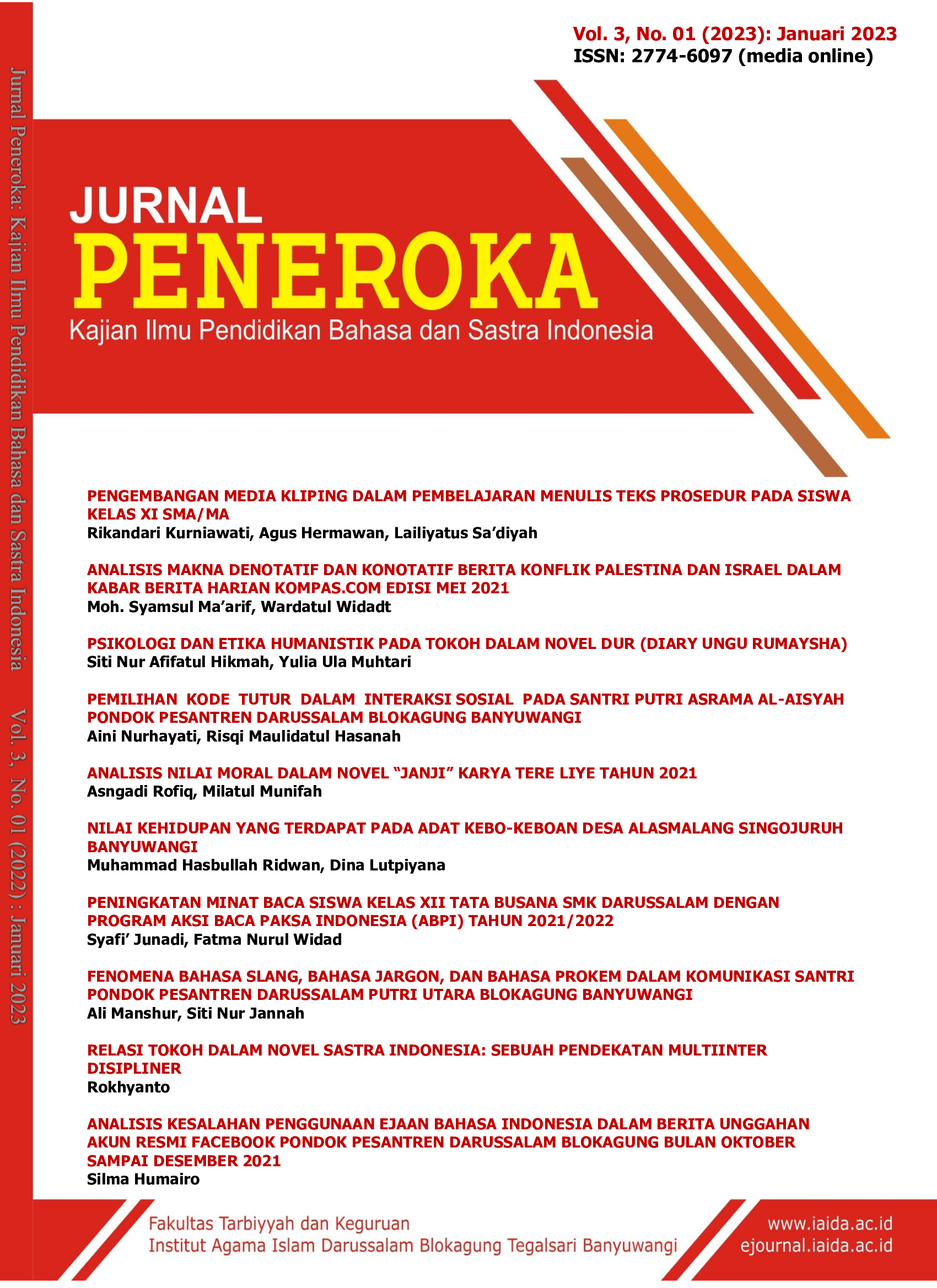
NILAI KEHIDUPAN YANG TERDAPAT PADA ADAT KEBO-KEBOAN DESA ALASMALANG SINGOJURUH BANYUWANGI
DOI:
https://doi.org/10.30739/peneroka.v3i1.1929Keywords:
Values, Customs, FolkloreAbstract
Adat as ancestral heritage plays an important role in people's lives. Adat is one of the studies of folklore. At the tip of the island of East Java, there is an area that has a lot of customs, namely Banyuwangi Regency. Banyuwangi Regency is famous for its Using Tribe. One of the famous Using Tribes in Banyuwangi is Singojuruh District. In Singojuruh District there is a kebo-keboan custom, this custom is carried out once a year. The focus of the research in this title is how to prepare and process the implementation of the kebo-keboan custom in Alasmalang Village and how the value of life is contained in the kebo-keboan custom. This study uses a partially oral folklore study. The method used in this study is a type of field qualitative research using data analysis methods, in this case, the researcher takes the title "the value of life contained in the kebo-keboan custom of Alasmalang Singojuruh Village, Banyuwangi". Researchers in obtaining data using observation techniques, interviews and documentation. This research resulted in 12 data from 4 different sources. This data explains the preparation and implementation procession in the kebo-keboan custom in Alasmalang Singojuruh Village, Banyuwangi. And then from the preparatory procession to the implementation of the kebo-keboan custom, there is a life value in it, where the values ??of life are very useful for the people of Krajan Hamlet, Alasmalang Village
Downloads
References
Abdulsyani.2007. Sosiologi Skematika, Teori, dan Terapan.Bandar Lampung: Bumi
Aksara
Agus, Bustanuddin. 2010. Agama dan Fenomena Sosial.Jakarta:UI-Press
Chotimah, Yeti.2020. Sejarah, Seni, dan Budaya Banyuwangi.Yogyakarta: Sulur
Pustaka
Endraswara, Suwardi.2017. Metodologi Penelitian Kebudayaan. Yogyakarta: Gadjah Mada University Press
Harahap, Nursapia.2020. Penelitian Kualitatif. Sumatera Utara. Wal Ashri Publishing
Jauhari, Hari.2018. Folklor Bahan Kajian Ilmu Budaya, Sastra, dan Sejarah.Bandung: Yrama Widya
Keraf, Gorys.2010. Diksi dan Gaya Bahasa. Jakarta: PT Gramedia Pustaka Utama
Koentjaraningrat. 2015. Pengantar Ilmu Antropologi. Jakarta: Rineka Cipta
Lestari, Dinna Eka Graha. 2020. Dinamika Perubahan Sosial Upacara Adat Kebo-Keboan pada Masyarakat Using Desa Alasmalang Kecamatan Singojuruh Kebupaten Banyuwangi. (Jurnal Utbag Kebijakan, Vol. 14, No.2, Desember).2020
Ndara, Taliziduhu.2005. Teori Budaya Organisasi.Jakarta: Rineka Cipta
Nurgiyantoro, Burhan.2015. Teori Pengkajian Fiksi.Yogyakarta: Gadjah Mada University Press
Pradopo, Rachmat Djoko.2020. Stilistika.Yogyakarta: Gadjah Mada University Press
Rizal, Maulfi Syaiful dan Vina Walida. 2020. Apokaliptik Sastra Dalam Tradisi Kebo-Keboan Desa Alasmalang, Banyuwangi. (Jurnal Sastra Jawa, Vol. 8, No.2).2020
Soekanto, Soerjono.2017. Sosiologi Suatu Pengantar. Jakarta: Rajawali Pers
Suyitno. 2018. Metode Penelitian Kualitatif: Konsep, Prinsip dan Operasionalnya. Tulungagung: Akademia Pustaka
Yesika, Hanna dan Lenny Novianti. Analisis Nilai-Nilai Kehidupan Batak Toba Pada Tradisi “Mamboan Sipanganon Tu Tulang”. (Jurnal Basataka, Vol.3, No.2, Desember).2020
Downloads
Published
How to Cite
Issue
Section
Citation Check
License
Copyright (c) 2023 Muhammad Hasbullah Ridwan, Dina Lutpiyana

This work is licensed under a Creative Commons Attribution-ShareAlike 4.0 International License.
Authors who publish in Jurnal PENEROKA: Kajian Ilmu Pendidikan Bahasa dan Sastra Indonesia agree to the following terms:
- Authors retain copyright and grant the journal right of first publication with the work simultaneously licensed under a Attribution-ShareAlike 4.0 International (CC BY-SA 4.0) License that allows others to share the work with an acknowledgment of the work's authorship and initial publication in this journal.
- Authors are able to enter into separate, additional contractual arrangements for the non-exclusive distribution of the journal's published version of the work (e.g., post it to an institutional repository or publish it in a book), with an acknowledgment of its initial publication in this journal.
- Authors are permitted and encouraged to post their work online (e.g., in institutional repositories or on their website) prior to and during the submission process, as it can lead to productive exchanges, as well as earlier and greater citation of published work (See The Effect of Open Access).