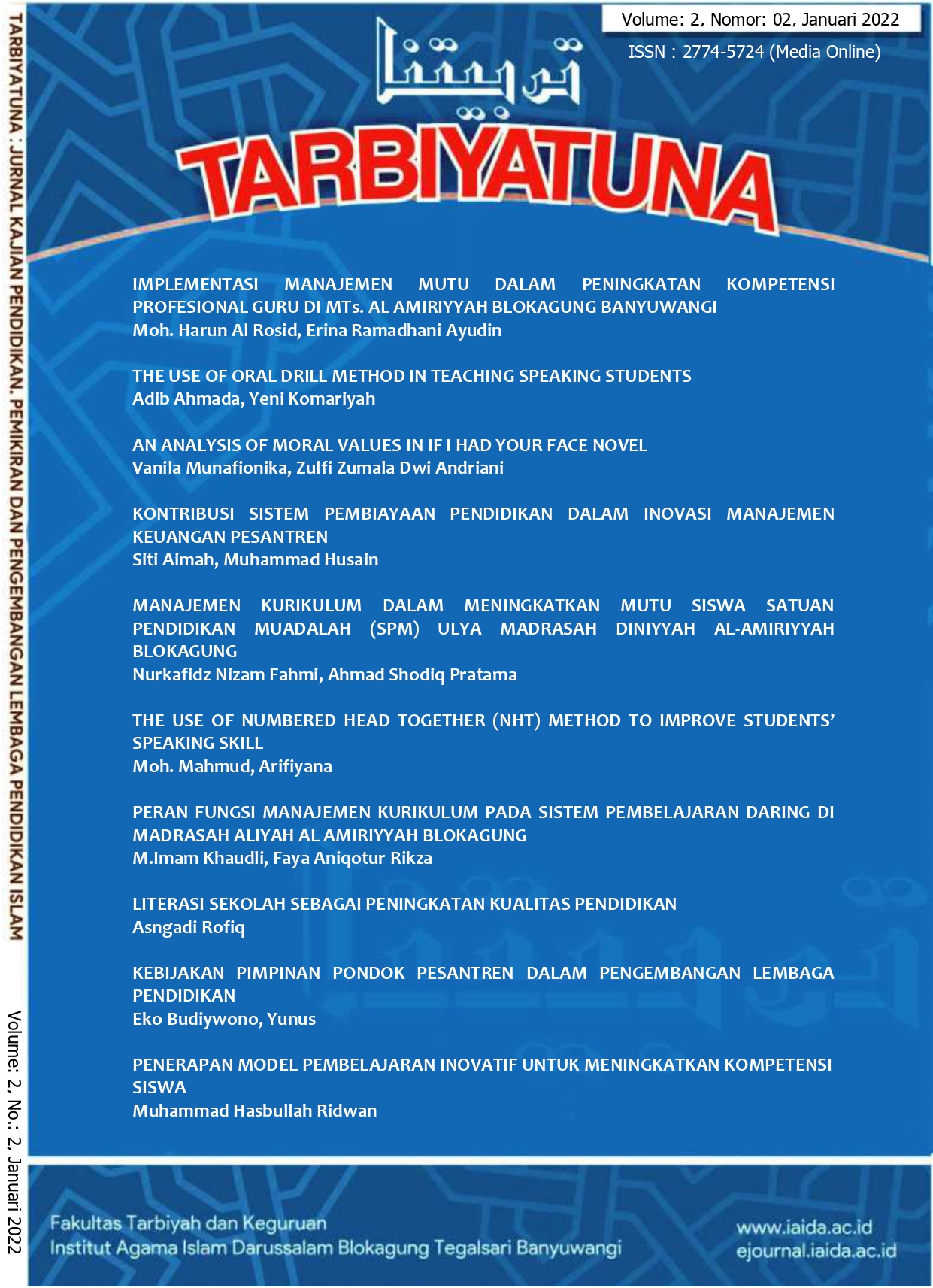
THE USE OF ORAL DRILL METHOD IN TEACHING SPEAKING STUDENTS
DOI:
https://doi.org/10.30739/tarbiyatuna.v2i2.1352Abstract
English is one of the most difficult subjects in Indonesia. Almost all students in Indonesia are afraid to speak English. Therefore, speaking is one of the important competencies that must e mastered by students at school. There are various methods that can be used for teaching speaking, one of which is the oral drill method. Several previous studies stated the oral drill method was effectively used to improve speaking skills. The researcher looked at the use of the oral drill method in teaching speaking by using a qualitative descriptive research design. The researcher was conducted on eighth grade excellent class of MTs Al-Amiriyyah in the academic year 2020/2021. The researcher conducted research instruments by classroom observation, Interviews, and Documentation. The result of the analysis is as follows: 1) the students' ability in speaking English lacking before using the oral drill method 2) the students are afraid to speak English because they lack vocabulary and are unconfident speaking English. 3) There are changes in students after using the oral drill method. They are more active in participating in learning English so it can be concluded that the teaching method using the oral drill is effective in improving speaking skills.
Downloads
Downloads
Published
How to Cite
Issue
Section
Citation Check
License
Authors who publish in Jurnal Tarbiyatuna: Jurnal Kajian Pendidikan, Pemikiran dan Pengembangan Pendidikan Islam agree to the following terms:
- Authors retain copyright and grant the journal right of first publication with the work simultaneously licensed under a Attribution-ShareAlike 4.0 International (CC BY-SA 4.0) Licensethat allows others to share the work with an acknowledgment of the work's authorship and initial publication in this journal.
- Authors are able to enter into separate, additional contractual arrangements for the non-exclusive distribution of the journal's published version of the work (e.g., post it to an institutional repository or publish it in a book), with an acknowledgment of its initial publication in this journal.
- Authors are permitted and encouraged to post their work online (e.g., in institutional repositories or on their website) prior to and during the submission process, as it can lead to productive exchanges, as well as earlier and greater citation of published work (See The Effect of Open Access).