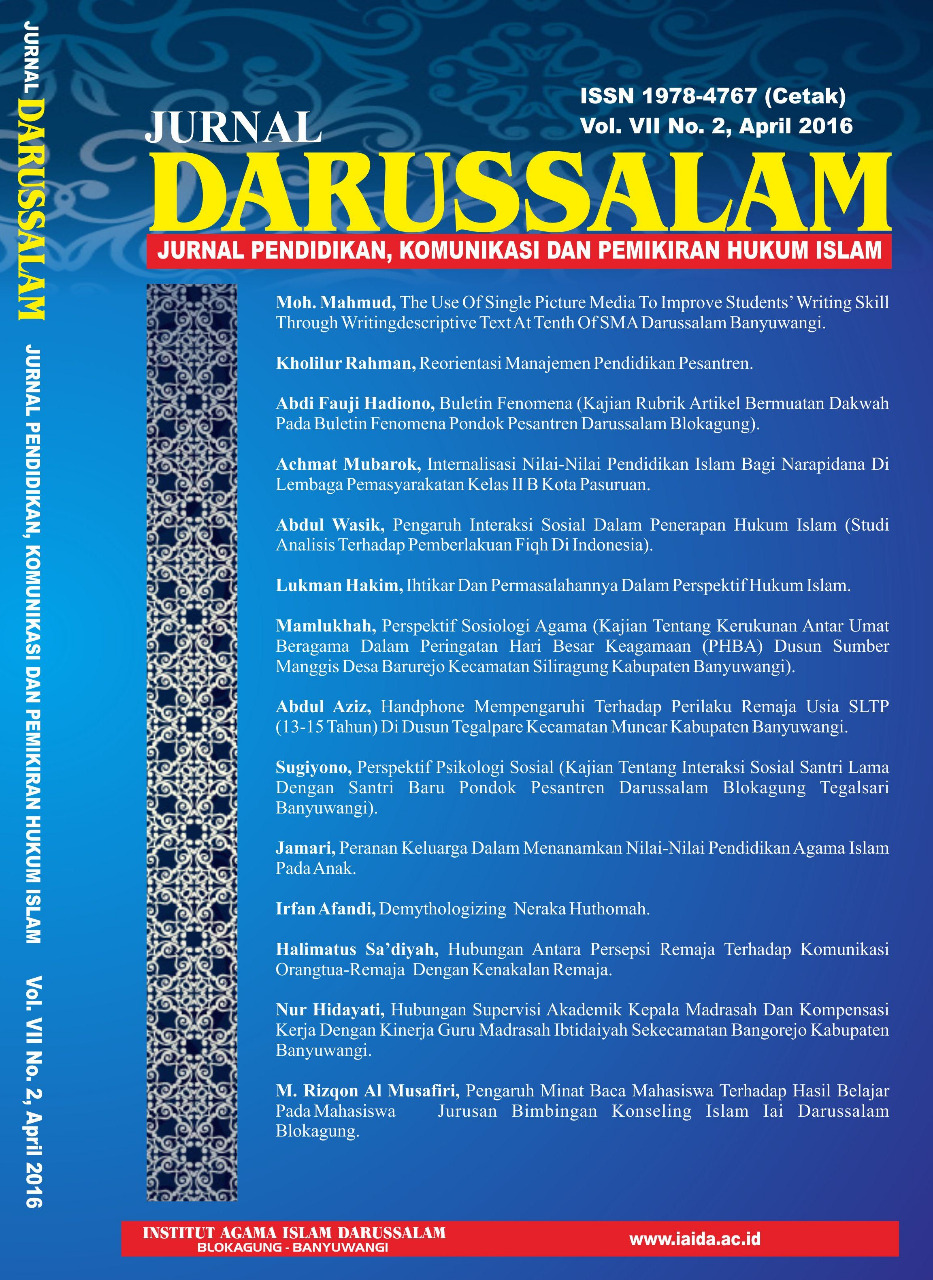
Reorientasi Manajemen Pendidikan Pesantren
DOI:
https://doi.org/10.30739/darussalam.v7i2.16Keywords:
Reorientsai, Management Pesantren EducationAbstract
This paper departs from the government's appreciation of some of the success of boarding school education. The authenticity and uniqueness of the pesantren cottage in addition to the treasures of the nation's cultural tradition is also a pillar supporting force of education to bring up the leaders of a moral nation. It is this reality that demands the management of educational institutions according to the demands of the times. The kiai's charismatic leadership in pesantren tends to embrace a centralized management system, and the implications of educational reforms encourage the emergence of formal education institutions that embrace a decentralized management system. The dichotomy of the two management systems demands a strategic step by applying a new, solutive model of leadership. A solution of the leadership model by developing a democratic leadership, ie leadership that appreciates the potential, ideas and work of all parties, both kiai as the leader of the santri as a guided individual. This requires a re-orientation of the pesantren education management system. In short, the implementation of education management in boarding school needs to be re-orientation of the lofty ideals of boarding school. Reorientation of pesantren boarding school management that is urgent to undertake, among others: leadership management and, initial management. Nevertheless, this reorientation must still be grounded in the concept of "al-muhâfadzatu 'al-al-qadîmi al-shÄlih wa al-akhdu bi al-jadîdi al-ashlah" (preserving a good old culture, and engaging constructive and prospective new ideas)
Downloads
References
Adair, J& Allen, M. 2003. Time Management and Personal Development. London: Thorogood Publishing, Ltd.
Arifin, Imron. 1993. Kepemimpinan Kiai, Kasus Pondok Pesantren Tebuireng Malang: Kalimasahada.
Armstrong, M. 2009. Armstrong’s Handbook of Management and Leadership: A Guide to Managing for Results. Second Edition. London: Kogan Page.
Aqiel, Sa’id Siraj. 1999. Pesantren Masa Depan. Bandung: Pustaka Hidayah,
Ayub, E. Moh, Muhsin dan Ramlan Mardjoned. 1996. Manajemen Masjid. Jakarta: Gema Insani Press.
Blanchard, K. 2010. Leading at a Higher Level: Blanchard on Leadership and Creating High Rerforming Organizations. Upper Saddle River. New Jersey: Pearson Prentice Hall.
Bush, T. 2008. Leadership and Management Development in Education. London: SAGE.
Dawam, Ainurrafiq dan Ahmad Ta’arifin. 2005. Manajemen Madrasah Berbasis Pesantren. Jakarta: Listafariska Putra.
Dhofier, Zamakhsyari. 1994. Tradisi Pesantren: Studi Tentang Pandangan Hidup Kyai. Jakarta: LP3ES.
Fattah. 2001. Landasan Manajemen Pendidikan. Cet. V. Bandung: PT. Remaja Rosdakarya,
file:///C:/Users/user/Downloads/inspirasiq-Manajemen-Pesantren.html. Diakses pada Tanggal 28 September 2016). Pukull 20.00 Wib.
Hoy, W.K. & Miskel, C. G. 2013. Educational Administration: Theory, Research, and Practice. New York: Mc Graw-Hill.
Kartono, Kartini. 2011. Pemimpin dan Kepemimpinan: Apakah Kepemimpinan Abnomal itu?. Jakarta: Rajawali Pres.
Komariah, A.& Triatna, C. 2014. Leadership: Menuju Sekolah Efektif. Jakarta: Bumi Aksara.
MU YAPPI. 2008. Manajemen Pengembangan Pondok Pesantren. Cet. I. Jakarta: Media Nusantara.
Nawawi, H., Hadari, M. 2012. Kepemimpinan Yang Efektif. Yogyakarta: Gadjah Mada University Press.
Noor, Mahpuddin. 2006. Potret Dunia Pesantren. Bandung: Humaniora.
Pace, R.W. dan Faules, D. F. 2000. Komunikasi Organisasi: Strategi Meningkatkan Kinerja Perusahaan. (Terjemahan Deddy Mulyana). Bandung: Remaja Rosdakarya.
Qomar, Mujamil. 2008. Manajemen Pendidikan Islam. Jakarta: Penerbit Erlangga.
Ramayulis. 2002. Ilmu Pendidikan Islam. Jakarta: Kalam Mulia.
Rivai, V. & A. Arifin. 2013. Islamic Leadership: Membangun Super Leadership Melalui Kecerdasan Spiritual. Jakarta: Bumi Aksara.
Sukamto. 1999. Kepemimpinan Kiai dalam Pesantren. Jakarta: LP3ES.
Sulistyorini. 2009. Manajemen Pendidikan Islam. Yogyakarta: Teras.
Syafaruddin. 2005. Manajemen Lembaga Pendidikan Islam. Jakarta: Penerbit Ciputat Press.
Sulthon Masyhud, M. dan M. Khusnurridlo. 2003. Sistem Manajemen Pondok Pesantren. Cet I. Jakarta : Diva Pustaka.
Shrode A. William. 1999. Organization and Management Basic System Concepts. Malaysia: Irwin Book.
Soebahar, Halim. 2013. Modernisasi Pesantren. Yogyakarta: Lkis.
Tilaar, H. A. R. 2008. Manajemen Pendidikan Nasional: Kajian Pendidikan Masa Depan. Bandung: Remaja Rosdakarya.
Usman, H. 2013. Manajemen: Teori, Praktik, dan Riset Pendidikan. Jakarta: Bumi Aksara.
Winarto, Paulus. 2003. First Step to be an Entrepreneur. Jakarta: Elex Media Komputindo.
Yacub, M. 2006. Pondok Pesantren dan Pembangunan Masyarakat Desa. Bandung: PT. Angkasa.
Zubaedi. 2006. Pendidikan Berbasis Masyarakat. Yogyakarta: Pustaka Pelajar.
Jurnal
Chamberlain, P. J. 2010. An Exploration of Leadership Capacity Building and Effective Principal Practices. Pro Quest. Jurnal.
Faj, Awaluddin. 2011. Manajemen Pendidikan Pesantren Dalam Perspektif Dr. KH. Abdullah Syukri Zarkasyi, M.A, Jurnal At-Ta’dib Vol. 6, No. 2.
Kisling, R. A. 2007. Character for Leadership: The Role of Personal Characteristics in Effective Leadership Behaviors. Pro Quest. Jurnal.
Rousselle, L. M. 2013. Examining School Climate and Effective Leadership in Relation to School Success. Pro Quest. Jurnal.
Wilkey, G. G. 2013. Research into the Characteristics of Effective High School Principals: A Case Study of Leadership Practices Used in the High School Setting. ProQuest. Jurnal
Downloads
Published
Issue
Section
Citation Check
License
Semua artikel yang dipublikasikan dapat diakses secara umum melalui online dan bersifat bebas download
http://creativecommons.org/licenses/by-sa/4.0/