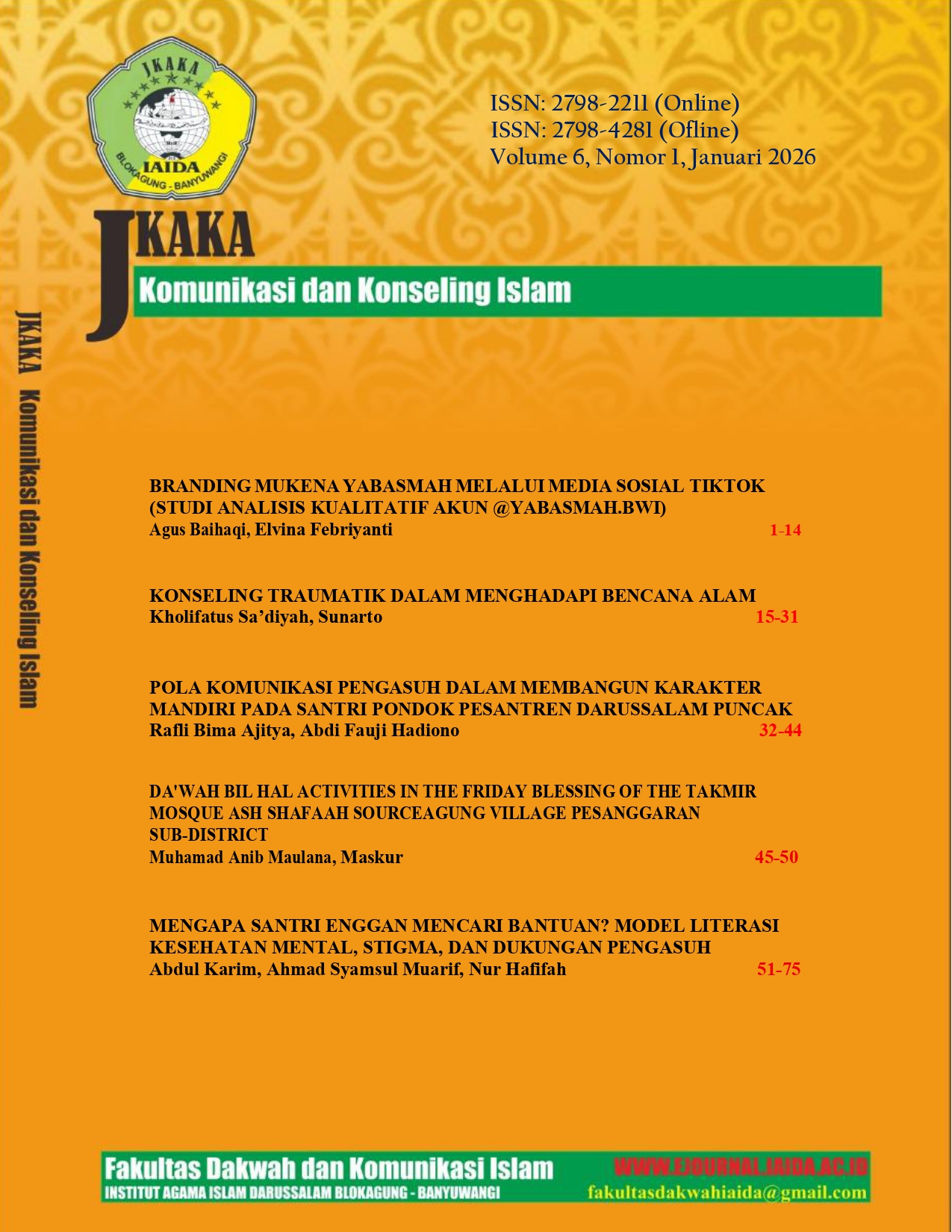
MENGAPA SANTRI ENGGAN MENCARI BANTUAN? MODEL LITERASI KESEHATAN MENTAL, STIGMA, DAN DUKUNGAN PENGASUH
DOI:
https://doi.org/10.30739/jkaka.v6i1.5409Keywords:
caregiver support, help-seeking, mental health literacy, santri, stigma, Caregiver Support, Help-Seeking, Mental Health Literacy, Santri, StigmaAbstract
Santri may experience psychological distress but delay or avoid formal help. This integrative review develops a contextual model explaining how mental health literacy, stigma, and caregiver support shape help-seeking in Indonesian Islamic boarding schools. Thirty core publications published mainly between 2016 and 2026 were purposively synthesized through thematic comparison and mechanism mapping. The review shows that literacy improves problem recognition and knowledge of services, but knowledge alone does not ensure action. Public and self-stigma interrupt the translation of recognition into help-seeking, particularly when distress is interpreted as personal or religious weakness. Caregiver support provides legitimacy, confidentiality, emotional safety, access, and referral, thereby reducing stigma and strengthening the conversion of literacy into action. These findings generate the LSP-Santri Model, which positions caregiver support as a contextual bridge and buffering mechanism. The model offers a basis for future empirical testing and for designing pesantren-based, Islamic-integrated, tiered mental health services.
Downloads
References
Aiyub, I., Jannah, S. R., Marthoenis, M., Abdullah, A., & Sofyan, H. (2023). Peer stigma, consequences, and anti-stigma strategies in adolescents with mental disorders: A qualitative investigation. Journal of Public Mental Health, 22(2), 60–72. doi: 10.1108/JPMH-09-2022-0095
Berry, C., Michelson, D., Othman, E., Tan, J. C., Gee, B., Hodgekins, J., Byrne, R. E., Ng, A. L. O., Marsh, N. V., Coker, S., & Fowler, D. (2020). Views of young people in Malaysia on mental health, help-seeking and unusual psychological experiences. Early Intervention in Psychiatry, 14(1), 115–123. doi: 10.1111/eip.12832
Center for Reproductive Health, University of Queensland, & Johns Hopkins Bloomberg School of Public Health. (2022). Indonesia—National Adolescent Mental Health Survey (I-NAMHS) Report. Brisbane: Center for Reproductive Health.
Cheng, H.-L., Wang, C., McDermott, R. C., Kridel, M., & Rislin, J. L. (2018). Self-stigma, mental health literacy, and attitudes toward seeking psychological help. Journal of Counseling & Development, 96(1), 64–74. doi: 10.1002/jcad.12178
Corrigan, P. W. (2004). How stigma interferes with mental health care. American Psychologist, 59(7), 614–625. doi: 10.1037/0003-066X.59.7.614
Corry, D. A. S., & Leavey, G. (2017). Adolescent trust and primary care: Help-seeking for emotional and psychological difficulties. Journal of Adolescence, 54, 1–8. doi: 10.1016/j.adolescence.2016.11.003
El-Mukhayyarah, A. (2024). Hubungan antara literasi kesehatan mental dan stigma diri terhadap intensi mencari bantuan pada santri laki-laki di Pondok Pesantren X Kota Pekanbaru. Skripsi tidak dipublikasikan. Universitas Islam Negeri Sultan Syarif Kasim Riau, Pekanbaru.
Hammer, J. H., Vogel, D. L., Grzanka, P. R., Kim, N., Keum, B. T., Adams, C., & Wilson, S. A. (2024). The integrated behavioral model of mental health help seeking (IBM-HS): A health services utilization theory of planned behavior for accessing care. Journal of Counseling Psychology, 71(5), 315–327. doi: 10.1037/cou0000754
Hartini, N., Fardana, N. A., Ariana, A. D., & Wardana, N. D. (2018). Stigma toward people with mental health problems in Indonesia. Psychology Research and Behavior Management, 11, 535–541. doi: 10.2147/PRBM.S175251
Hastasari, C., Setiawan, B., & Aw, S. (2022). Students’ communication patterns of Islamic boarding schools: The case of students in Muallimin Muhammadiyah Yogyakarta. Heliyon, 8(1), e08824. doi: 10.1016/j.heliyon.2022.e08824
Ibrahim, N., Mohd Safien, A., Siau, C. S., & Shahar, S. (2020). The effectiveness of a depression literacy program on stigma and mental help-seeking among adolescents in Malaysia: A control group study with 3-month follow-up. Inquiry, 57, 1–10. doi: 10.1177/0046958020902332
Izfanna, D., Darojat, M. H., Kamalie, H. S., & Fitriana, M. (2026). Islamic-integrated mental health awareness program and students’ mental health literacy in Pondok Pesantren Darunnajah: A mixed-method study. Psikis: Jurnal Psikologi Islami, 12(1), 121–134. doi: 10.19109/psikis.v12i1.32831
Jorm, A. F., Korten, A. E., Jacomb, P. A., Christensen, H., Rodgers, B., & Pollitt, P. (1997). Mental health literacy: A survey of the public’s ability to recognise mental disorders and beliefs about treatment. Medical Journal of Australia, 166(4), 182–186. doi: 10.5694/j.1326-5377.1997.tb140071.x
Kaligis, F., Ismail, R. I., Wiguna, T., Prasetyo, S., Indriatmi, W., Gunardi, H., Pandia, V., & Magdalena, C. C. (2021). Mental health problems and needs among transitional-age youth in Indonesia. International Journal of Environmental Research and Public Health, 18(8), 4046. doi: 10.3390/ijerph18084046
Kartiani, A. (2024). Bridging the gap: Help seeking behavior and mental health service utilization among Indonesian adolescents. Medicor: Journal of Health Informatics and Health Policy, 2(2), 101–112. doi: 10.61978/medicor.v2i2.747
Kartikasari, N., & Ariana, A. D. (2019). Hubungan antara literasi kesehatan mental, stigma diri terhadap intensi mencari bantuan pada dewasa awal. INSAN Jurnal Psikologi dan Kesehatan Mental, 4(2), 64–75. doi: 10.20473/jpkm.V4I22019.64-75
Lesmana, M. H. S., & Chung, M.-H. (2024). Mediating roles of perceived stigma and mental health literacy in the relationship between school climate and help-seeking behavior in Indonesian adolescents. PLoS ONE, 19(5), e0298017. doi: 10.1371/journal.pone.0298017
Lindow, J. C., Hughes, J. L., South, C., Minhajuddin, A., Gutierrez, L., Bannister, E., Trivedi, M. H., & Byerly, M. J. (2020). The Youth Aware of Mental Health intervention: Impact on help seeking, mental health knowledge, and stigma in U.S. adolescents. Journal of Adolescent Health, 67(1), 101–107. doi: 10.1016/j.jadohealth.2020.01.006
Lubman, D. I., Cheetham, A., Jorm, A. F., Berridge, B. J., Wilson, C., Blee, F., McKay-Brown, L., Allen, N., & Proimos, J. (2017). Australian adolescents’ beliefs and help-seeking intentions towards peers experiencing symptoms of depression and alcohol misuse. BMC Public Health, 17, 658. doi: 10.1186/s12889-017-4655-3
Memon, A., Taylor, K., Mohebati, L. M., Sundin, J., Cooper, M., Scanlon, T., & de Visser, R. (2016). Perceived barriers to accessing mental health services among Black and minority ethnic communities: A qualitative study in Southeast England. BMJ Open, 6, e012337. doi: 10.1136/bmjopen-2016-012337
Milin, R., Kutcher, S., Lewis, S. P., Walker, S., Wei, Y., Ferrill, N., & Armstrong, M. A. (2016). Impact of a mental health curriculum on knowledge and stigma among high school students: A randomized controlled trial. Journal of the American Academy of Child & Adolescent Psychiatry, 55(5), 383–391.e1. doi: 10.1016/j.jaac.2016.02.018
Nasution, S., Pohan, A. J., Khairurrijal, Nur, K., & Putriani, Z. (2025). Empowering santri well-being: Integrating spiritual practices and SEL in pesantren mental health. Cendekia: Jurnal Kependidikan dan Kemasyarakatan, 23(1), 121–141. doi: 10.21154/cendekia.v23i1.10526
Nearchou, F. A., Bird, N., Costello, A., Duggan, S., Gilroy, J., Long, R., McHugh, L., & Hennessy, E. (2018). Personal and perceived public mental-health stigma as predictors of help-seeking intentions in adolescents. Journal of Adolescence, 66, 83–90. doi: 10.1016/j.adolescence.2018.05.003
Pakerti, M. I., & Ariana, A. D. (2024). Hubungan literasi kesehatan mental dan stigma diri dengan intensi mencari bantuan pada remaja. Jurnal Ilmu Psikologi dan Kesehatan (SIKONTAN), 2(4), 309–322. doi: 10.47353/sikontan.v2i4.758
Radez, J., Reardon, T., Creswell, C., Lawrence, P. J., Evdoka-Burton, G., & Waite, P. (2021). Why do children and adolescents (not) seek and access professional help for their mental health problems? A systematic review. European Child & Adolescent Psychiatry, 30(2), 183–211. doi: 10.1007/s00787-019-01469-4
Rafal, G., Gatto, A., & DeBate, R. (2018). Mental health literacy, stigma, and help-seeking behaviors among male college students. Journal of American College Health, 66(4), 284–291. doi: 10.1080/07448481.2018.1434780
Singh, S., Zaki, R. A., Farid, N. D. N., & Kaur, K. (2022). The determinants of mental health literacy among young adolescents in Malaysia. International Journal of Environmental Research and Public Health, 19(6), 3242. doi: 10.3390/ijerph19063242
Tan, G. T. H., Shahwan, S., Goh, C. M. J., Ong, W. J., Samari, E., Abdin, E., Kwok, K. W., Chong, S. A., & Subramaniam, M. (2020). Causal beliefs of mental illness and its impact on help-seeking attitudes: A cross-sectional study among university students in Singapore. BMJ Open, 10(7), e035818. doi: 10.1136/bmjopen-2019-035818
Tanhan, A., & Young, J. S. (2022). Muslims and mental health services: A concept map and a theoretical framework. Journal of Religion and Health, 61, 23–63. doi: 10.1007/s10943-021-01324-4
Velasco, A. A., Cruz, I. S. S., Billings, J., Jimenez, M., & Rowe, S. (2020). What are the barriers, facilitators and interventions targeting help-seeking behaviours for common mental health problems in adolescents? A systematic review. BMC Psychiatry, 20, 293. doi: 10.1186/s12888-020-02659-0
Downloads
Published
Issue
Section
Citation Check
License
Copyright (c) 2026 Abdul karim, ahmad syamsul muarif, Nur Hafifah

This work is licensed under a Creative Commons Attribution-ShareAlike 4.0 International License.
Authors who publish in JKaKa:Jurnal Komunikasi dan Konseling Islam agree to the following terms:
- Authors retain copyright and grant the journal right of first publication with the work simultaneously licensed under a Attribution-ShareAlike 4.0 International (CC BY-SA 4.0) License that allows others to share the work with an acknowledgment of the work's authorship and initial publication in this journal.
- Authors are able to enter into separate, additional contractual arrangements for the non-exclusive distribution of the journal's published version of the work (e.g., post it to an institutional repository or publish it in a book), with an acknowledgment of its initial publication in this journal.
- Authors are permitted and encouraged to post their work online (e.g., in institutional repositories or on their website) prior to and during the submission process, as it can lead to productive exchanges, as well as earlier and greater citation of published work (See The Effect of Open Access).