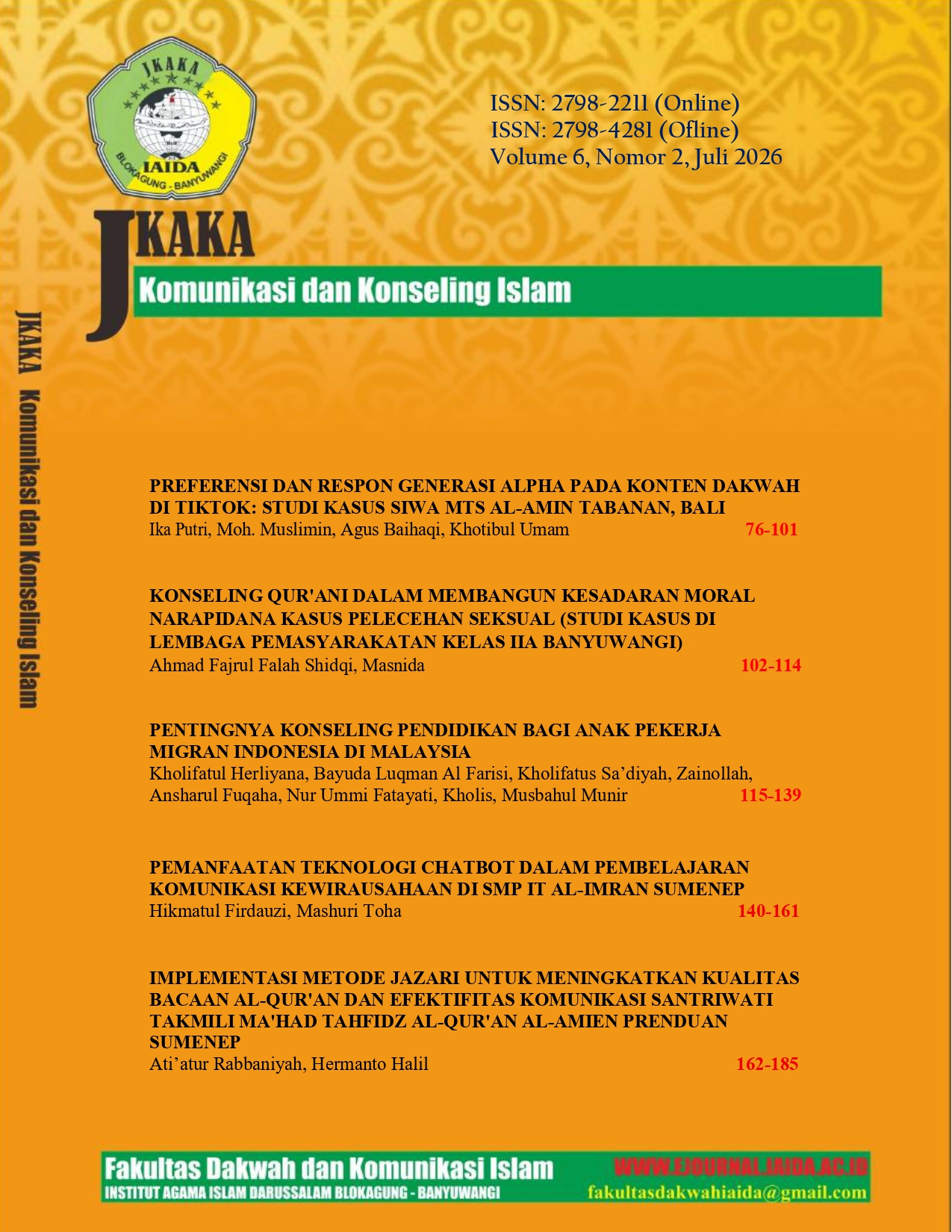
PENTINGNYA KONSELING PENDIDIKAN BAGI ANAK WARGA NEGARA ASING (WNA) DI MALAYSIA
DOI:
https://doi.org/10.30739/jkaka.v6i2.5486Abstract
Downloads
References
Abdallah Altarawneh, A. M., & Awwad Alomoush, R. A. (2022). The reality of e-counseling services in the light of digital learning from the point of view of teachers in Jordan. Education and Information Technologies, 27(9), 12773–12792. https://doi.org/10.1007/s10639-022-11102-8
Abdillah, H., Setyosari, P., Lasan, B., & Muslihati, M. (2020). The acceptance of school counselor in the use of ICT during school from home in the Covid-19 era. Journal for the Education of Gifted Young Scientists, 8(4), 1569–1582. https://doi.org/10.17478/jegys.804939
American School Counselor Association. (2019). The school counselor and cultural diversity [Position statement]. https://www.schoolcounselor.org/Standards-Positions/Position-Statements/ASCA-Position-Statements/The-School-Counselor-and-Cultural-Diversity
American School Counselor Association. (2022). Telecounseling is gaining momentum. ASCA School Counselor Magazine. https://www.schoolcounselor.org/Magazines/May-June-2022/Telecounseling-is-Gaining-Momentum
Chow, S. K., Hashim, A. H., Kaur, M., Azhar, F. L., Anuar, A., Idris, N., Hii, W. S. S., & Ng, C. G. (2024). Strengthening the mental health literacy and self-efficacy of school counsellors using "MDAS" module: A pilot project in Malaysia. SAGE Open Medicine. https://doi.org/10.1177/20556365241279331
Institute for Democracy and Economic Affairs (IDEAS) & UNICEF Malaysia. (2022). Left far behind: The impact of COVID-19 on access to education and healthcare for refugee and asylum-seeking children in Peninsular Malaysia. https://www.unicef.org/malaysia/press-releases/ideas-unicef-refugee-asylum-seeking-childrens-rights
Jones, E. E., Reed, M., Meyer, A. H., Gaab, J., & Ooi, Y. P. (2023). Stress, mental health and sociocultural adjustment in third culture kids: Exploring the mediating roles of resilience and family functioning. Frontiers in Psychology, 14, 1093046. https://doi.org/10.3389/fpsyg.2023.1093046
Lee, W. R., Zainudin, Z. N., & Kamarudin, E. M. E. (2025). Counselling self-efficacy as a mediator between computer self-efficacy and attitudes toward tele-mental health among school counsellors in Malaysia. PLOS ONE. https://doi.org/10.1371/journal.pone.0335955
Loganathan, T., Chan, Z. X., Hassan, F., Kunpeuk, W., Suphanchaimat, R., Yi, H., & Majid, H. A. (2021). Education for non-citizen children in Malaysia during the COVID-19 pandemic: A qualitative study. PLOS ONE, 16(12), e0259546. https://doi.org/10.1371/journal.pone.0259546
Loganathan, T., Chan, Z. X., Hassan, F., Ong, Z. L., & Majid, H. A. (2022). Undocumented: An examination of legal identity and education provision for children in Malaysia. PLOS ONE, 17(2), e0263404. https://doi.org/10.1371/journal.pone.0263404
Loganathan, T., Chan, Z. X., Hassan, F., Ong, Z. L., & Majid, H. A. (2023). Barriers and facilitators to education access for marginalised non-citizen children in Malaysia: A qualitative study. PLOS ONE. https://doi.org/10.1371/journal.pone.0286793
Medari?, Z., Gornik, B., & Sedmak, M. (2022). What about the family? The role and meaning of family in the integration of migrant children: Evidence from Slovenian schools. Frontiers in Education, 7, 1003759. https://doi.org/10.3389/feduc.2022.1003759
Melnikova, J. (2022). Migrant parents at high school: Exploring new opportunities for involvement. Frontiers in Education, 7, 979399. https://doi.org/10.3389/feduc.2022.979399
Mollen, D., & Ridley, C. R. (2021). Rethinking multicultural counseling competence: An introduction to the major contribution. The Counseling Psychologist, 49(4), 490–503. https://doi.org/10.1177/0011000020986543
O'Hara, C., et al. (2021). Multicultural competence in counseling research: The cornerstone of scholarship. Journal of Counseling & Development, 99(2). https://doi.org/10.1002/jcad.12367
Ooi, P. B., Wan Jaafar, W. M., & Crosling, G. (2021). Malaysian school counselor's self-efficacy: The key roles of supervisor support for training, mastery experience, and access to training. Frontiers in Psychology, 12, 749225. https://doi.org/10.3389/fpsyg.2021.749225
Ridley, C. R., Sahu, A., Console, K., Surya, S., Tran, V., Xie, S., & Yin, C. (2021). The process model of multicultural counseling competence. The Counseling Psychologist, 49(4), 504–555. https://doi.org/10.1177/0011000021992339
ScienceDirect. (2026). Perceptions and strategies for the inclusion of migrant students: A systematic review. https://www.sciencedirect.com/science/article/pii/S0883035526000716
U.S. Committee for Refugees and Immigrants (Refugees.org). (2024). International Day Against Violence & Bullying at School. https://refugees.org/international-day-against-violence-bullying-at-school/
UNICEF Malaysia. (2024). World Refugee Day: UNICEF's statement on access to education for refugee and stateless children. https://malaysia.un.org/en/272114-worldrefugeeday-unicef%E2%80%99s-statement-access-education-refugee-and-stateless-children
Yulianto, M. I., Mahardhani, A. J., Sulton, S., & Majid, I. A. (2023). The role of the government of Indonesia in fighting for recognition and the right to education for children of Indonesia migrant workers in Malaysia. Jurnal Public Policy, 9(3), 159–163. https://doi.org/10.35308/jpp.v9i3.7059
Downloads
Published
Issue
Section
Citation Check
License
Copyright (c) 2026 kholifatul Herliyana, Kholifatus Sa’diyah, Nur Ummi Fatayati, Bayuda Luqman Al Farisi, Zainollah Zainollah, Ansharul Fuqaha, Kholis Kholis

This work is licensed under a Creative Commons Attribution-ShareAlike 4.0 International License.
Authors who publish in JKaKa:Jurnal Komunikasi dan Konseling Islam agree to the following terms:
- Authors retain copyright and grant the journal right of first publication with the work simultaneously licensed under a Attribution-ShareAlike 4.0 International (CC BY-SA 4.0) License that allows others to share the work with an acknowledgment of the work's authorship and initial publication in this journal.
- Authors are able to enter into separate, additional contractual arrangements for the non-exclusive distribution of the journal's published version of the work (e.g., post it to an institutional repository or publish it in a book), with an acknowledgment of its initial publication in this journal.
- Authors are permitted and encouraged to post their work online (e.g., in institutional repositories or on their website) prior to and during the submission process, as it can lead to productive exchanges, as well as earlier and greater citation of published work (See The Effect of Open Access).