Author Guidelines
JPSDa: Jurnal Perbankan Syariah Darussalam
Institut Agama Islam Darussalam (IAIDA), Blokagung, Banyuwangi, East Java, Indonesia
ISSN: 2775-6084 (online) | Sinta 5: No 72/E/KPT/2024 | DOI Prefix: 10.30739/jpsda
https://ejournal.uimsya.ac.id/index.php/JPSDa
Licensed under Creative Commons Attribution-ShareAlike 4.0 International (CC BY-SA 4.0)
AUTHOR GUIDELINES
JPSDa: Jurnal Perbankan Syariah Darussalam welcomes original manuscripts in the fields of Islamic banking, Islamic finance, sharia economics, and related disciplines. All manuscripts must comply with these guidelines. Submissions that do not conform to the required format will be returned to authors prior to peer review.
- SCOPE AND ARTICLE TYPES
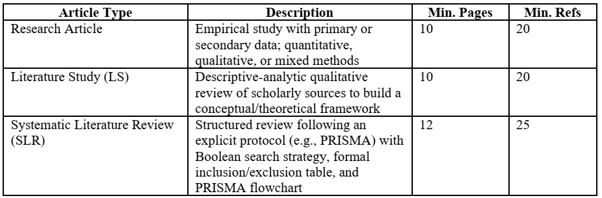
JPSDa accepts three types of scholarly manuscripts. Each type has a distinct structure, required methodology, and minimum reference count, as outlined below.
Table 1. Types of Manuscripts Accepted by JPSDa
- GENERAL REQUIREMENTS
2.1 Originality and Ethics
- Manuscripts must be original, unpublished, and not under review by any other journal.
- Simultaneous submission to multiple journals is strictly prohibited.
- All listed authors must have made substantive intellectual contributions to the work.
- Plagiarism, fabrication, falsification, and redundant publication are grounds for immediate rejection.
- Manuscripts are screened using plagiarism detection tools. Maximum similarity: 25% overall; no single source may exceed 5%.
- JPSDa follows the Committee on Publication Ethics (COPE) guidelines.
2.2 Language
- Manuscripts may be written in Indonesian or English.
- Indonesian manuscripts must conform to Ejaan Bahasa Indonesia yang Disempurnakan (EYD) standards.
- English manuscripts must use clear, formal academic language. Authors whose first language is not English are encouraged to have their manuscript proofread by a native speaker before submission.
- Both Indonesian and English abstracts are required, regardless of the manuscript's primary language.
2.3 File Format and Template
- Manuscripts must be submitted as a Microsoft Word (.docx) file.
- All manuscripts must be prepared using the official JPSDa template: https://ejournal.uimsya.ac.id/index.php/JPSDa/template
- Figures and diagrams must be embedded in the manuscript and also submitted as separate high-resolution image files (minimum 300 dpi, JPEG or PNG).
2.4 Page Layout
- Paper size: A4 (210 × 297 mm)
- Margins: Top 2.5 cm | Bottom 2.5 cm | Left 3 cm | Right 3 cm
- Font: Times New Roman throughout the manuscript
- Body text: 12 pt, justified alignment, 1.15 line spacing
- Single column layout
- MANUSCRIPT STRUCTURE
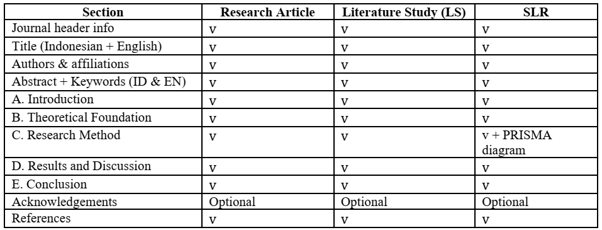
All manuscripts must follow the structure below. Section headings must appear in ALL CAPITALS, bold, 11 pt. Subsections use numbered format (1., 2., 3.) followed by lettered sub-subsections (a., b., c.) where applicable.
Table 2. Mandatory Sections by Article Type (v = Required)
3.1 Journal Header Information
The following information appears in the top-right area of the first page (9 pt Times New Roman):
- Received date | Reviewed date | Revised date | Accepted date | Published date (DD-MM-YYYY)
- Volume and issue: Vol.X / No.X: Page–Page, Month Year
- ISSN: 2775-6084 (online)
- DOI: 10.30739/jpsda.vXiX.XXXX
- Terakreditasi Sinta 5: No 72/E/KPT/2024
- Creative Commons license: CC BY-SA 4.0
3.2 Title
- Formatted in ALL CAPITALS, bold, 14 pt, centered.
- Both Indonesian and English titles are required.
- Maximum 16 words. The title must be informative, specific, and free of abbreviations.
- For LS and SLR articles, include the method type in the title.
- Example LS title: STRATEGI PENGUATAN MANAJEMEN RISIKO BANK SYARIAH (STUDI LITERATUR)
- Example SLR title: FAKTOR-FAKTOR YANG MEMPENGARUHI KINERJA BANK SYARIAH: SYSTEMATIC LITERATURE REVIEW
3.3 Authors and Affiliations
- Author names: full name, bold, 11 pt, centered. No academic titles or degrees.
- Superscript numbers (¹, ²) indicate affiliation for each author.
- Corresponding author is marked with an asterisk (*); their email address is required.
- Affiliation format: Program Study, Institution Name, City, Country.
- All authors' email addresses appear on a separate centered line below affiliations.
3.4 Abstract and Keywords
- Both Indonesian ("Abstrak") and English ("Abstract") versions are required.
- Each abstract: single paragraph, 150–200 words.
- Must include: (1) objective/purpose; (2) methodology; (3) main findings; (4) conclusion and implications.
- For LS: describe types of sources reviewed, databases searched, and main conceptual findings.
- For SLR: additionally state the number of articles identified, screened, and included in the final analysis.
- Keywords: 4–6 terms, separated by commas, lowercase (except proper nouns).
- "Kata Kunci:" and "Keywords:" labels must be bold.
3.5 A. Introduction
The Introduction should contain 3–5 paragraphs (400–700 words) covering:
- (1) Macro context — current phenomena, trends, or problems in Islamic banking/finance.
- (2) Specific context — significance of the topic for Indonesian Islamic banking practice.
- (3) Research gap — gaps or inconsistencies in existing literature that justify this study.
- (4) Research objective — explicit statement of the study's purpose.
- For LS and SLR: explicitly state the Research Questions (RQ) addressed.
- Minimum 5 references required in the Introduction.
3.6 B. Theoretical Foundation
This section presents the conceptual and theoretical framework underpinning the analysis. Organize into numbered subsections (1., 2., 3.) with lettered sub-subsections (a., b., c.) as needed. Each subsection addresses one key concept relevant to the research. Recommended length: 800–1,200 words. Minimum 8 primary references.
3.7 C. Research Method
Describe how the study was conducted, appropriate to the article type:
For Research Articles:
- Research design and approach (quantitative, qualitative, or mixed methods)
- Population, sample, and sampling technique
- Data collection instruments and validation procedures
- Data analysis techniques (statistical tools or qualitative methods)
For Literature Study (LS):
- State the qualitative/descriptive-analytic approach and literature study method.
- Identify databases searched (Google Scholar, Garuda, DOAJ, Scopus, etc.).
- Specify search keywords and publication year range.
- Describe selection criteria (types of sources included/excluded) — may be narrative.
- Specify analysis technique: content analysis, thematic analysis, or narrative synthesis.
For Systematic Literature Review (SLR):
- State the SLR protocol used (e.g., PRISMA).
- Provide the complete Boolean search string for each database.
- Present formal Inclusion/Exclusion Criteria in a table (required as Table 1).
- Include PRISMA flowchart with article counts at four stages: Identification, Screening, Eligibility, Inclusion (required as Figure 1).
- Describe data extraction variables and analysis technique (thematic synthesis, content analysis).
- State trustworthiness measures: data triangulation, peer debriefing, audit trail.
3.8 D. Results and Discussion
This section must be divided into two explicitly labeled sub-sections: "1. Results" and "2. Discussion." Use lettered sub-subsections (a., b., c.) under each, and numbered sub-points (1), 2), 3)) if further breakdown is needed.
In the Results sub-section:
- Present findings systematically, organized by research question or research objective.
- Support findings with data, tables, figures, and/or citations from analyzed sources.
- For SLR: include a summary table of analyzed articles and a theme distribution table.
In the Discussion sub-section:
- Critically interpret findings in relation to the Theoretical Foundation (Section B) and prior studies.
- Use explicit framing: "This finding is consistent with...", "This extends...", "This contradicts..."
- Identify practical implications for Islamic banking practice, policy, or regulation.
- Identify research gaps and recommend future research directions.
3.9 E. Conclusion
- Written as a narrative paragraph — not bullet points.
- Must directly answer each research question/objective from the Introduction.
- Include: (1) key findings; (2) study limitations; (3) recommendations for future research; (4) practical implications.
- Recommended length: 200–300 words.
- Do not introduce new data or references in the Conclusion.
3.10 References
- APA 7th Edition format. Use Mendeley, Zotero, or EndNote.
- Arranged alphabetically by first author's last name.
- Only include sources cited in the text.
- Minimum 80% must be peer-reviewed journal articles from the last 10 years.
- Minimum: 20 references (Research Article / LS); 25 references (SLR).
- Include DOI or URL for all online sources where available.
APA 7th Edition format examples:
Journal article: Author, A. A., & Author, B. B. (Year). Article title. Journal Name, Vol(Issue), pages. https://doi.org/xxxxx
Book: Author, A. A. (Year). Book title (Xth ed.). Publisher.
Book chapter: Author, A. A. (Year). Chapter title. In Editor Name (Ed.), Book title (pp. xx–xx). Publisher.
Institutional report: Institution. (Year). Report title. Publisher. https://url
- TABLES AND FIGURES
4.1 Tables
- Table caption: placed ABOVE the table, bold, centered. Format: "Table X. Title".
- Tables numbered sequentially: Table 1, Table 2, etc.
- Use "Table Grid" style with visible borders; column headers bold and centered.
- Font size inside tables: 10 pt.
- Every table must be cited in the text: e.g., "Table 1 shows..." or "(see Table 1)".
4.2 Figures
- Figure caption: placed BELOW the figure, bold, centered. Format: "Figure X. Title".
- Figures numbered sequentially: Figure 1, Figure 2, etc.
- Minimum resolution: 300 dpi.
- Every figure must be cited in the text.
- For SLR: PRISMA flowchart is required as Figure 1.
- IN-TEXT CITATION FORMAT
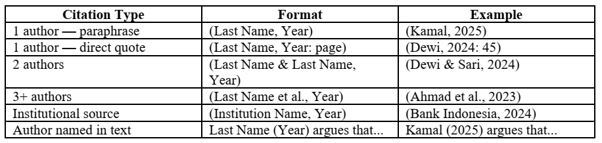
JPSDa uses APA 7th Edition in-text citation style. Do not use footnotes or endnotes.
Table 3. In-Text Citation Formats (APA 7th Edition)
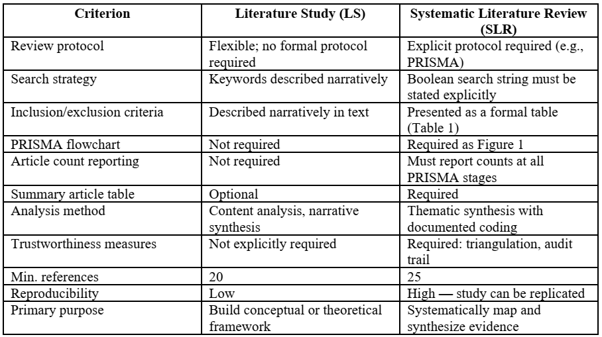
- KEY DIFFERENCES: LITERATURE STUDY vs. SYSTEMATIC LITERATURE REVIEW
Table 4. Differences between Literature Study (LS) and Systematic Literature Review (SLR)
- SUBMISSION PROCESS
7.1 Online Submission
- All manuscripts must be submitted through the OJS portal: https://ejournal.uimsya.ac.id/index.php/JPSDa
- Authors must register an account and select the "Author" role before submitting.
- Do not submit manuscripts via email unless instructed by the editorial office.
7.2 Required Submission Files
- Main manuscript (.docx) — anonymized (no author names or affiliations), prepared using the official template.
- Title page (.docx) — separate file with title, all authors' names, affiliations, and corresponding author contact details.
- Cover letter — addressed to the Editor-in-Chief, stating the manuscript's contribution and confirming originality.
- Similarity report (Turnitin/iThenticate) — max. 25% overall similarity; no single source exceeding 5%.
- High-resolution figure files (if applicable).
7.3 Review Process
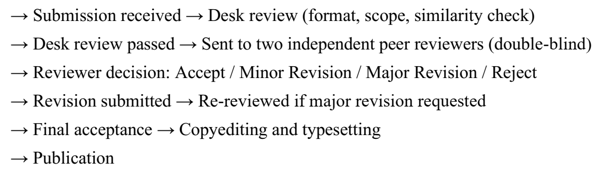
JPSDa uses double-blind peer review. All identifying information must be removed from the main manuscript file. The editorial process proceeds as follows:
7.4 Author Fees
JPSDa charges an Article Processing Charge (APC) for accepted manuscripts. Current APC details are available on the journal website. No submission fee is charged prior to acceptance.
- PUBLICATION ETHICS
- JPSDa adheres to COPE (Committee on Publication Ethics) guidelines.
- Authors are responsible for the accuracy of all data, citations, and statements.
- All listed authors must have made substantive contributions to the research, writing, or revision.
- Research funding sources must be disclosed in the Acknowledgements section.
- Any conflicts of interest must be declared at submission.
- Manuscripts based on theses or dissertations must disclose this at submission.
- The editorial board will investigate misconduct allegations and may retract published articles if misconduct is confirmed.
- SUBMISSION CHECKLIST
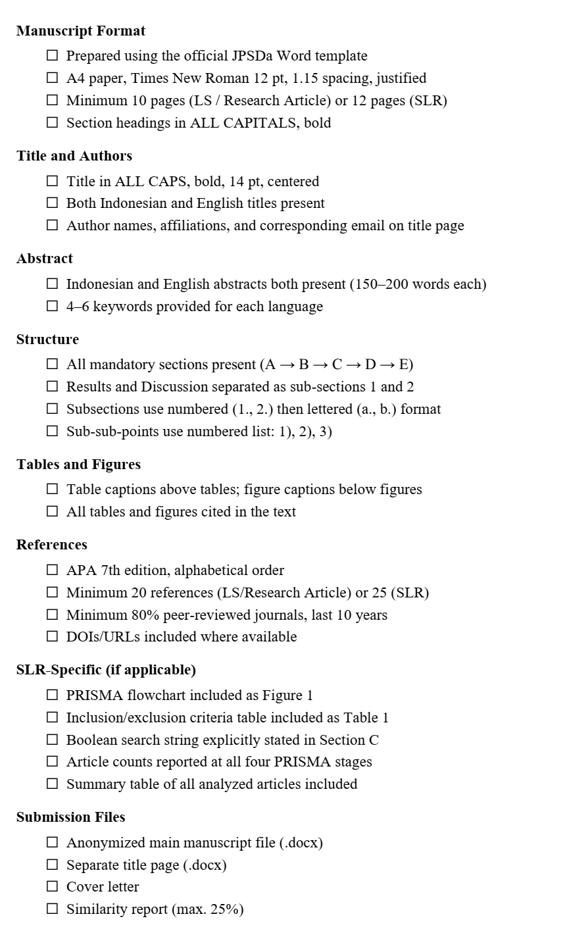
Please verify all items before submitting your manuscript:
CONTACT
JPSDa Editorial Office
Institut Agama Islam Darussalam (IAIDA), Blokagung, Banyuwangi, East Java, Indonesia
Email: [email protected]
Website: https://ejournal.uimsya.ac.id/index.php/JPSDa
These guidelines are effective as of 2026 and supersede all previous versions. The editorial board reserves the right to update these guidelines at any time. Authors are responsible for reviewing the most current version prior to submission.