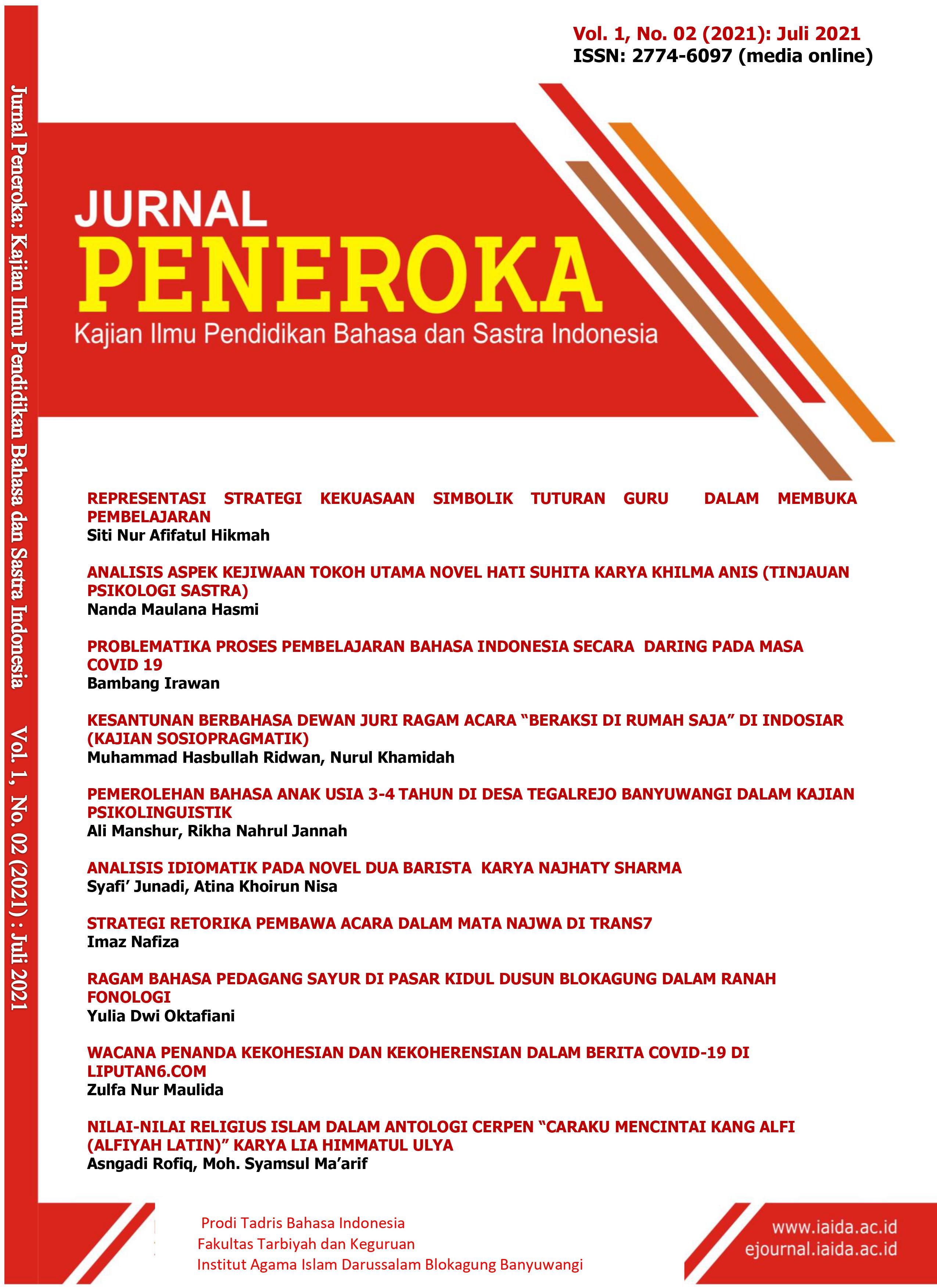
ANALISIS ASPEK KEJIWAAN TOKOH UTAMA NOVEL HATI SUHITA KARYA KHILMA ANIS (TINJAUAN PSIKOLOGI SASTRA
DOI:
https://doi.org/10.30739/peneroka.v1i02.984Keywords:
Character Character, Psychiatric, BackgroundAbstract
Literary work tries to describe human life, not only in relation to other humans, but also in relation to itself through the relationship of inner events. One form of literary work is novel. The birth of the novel is the creative result of the author in processing a story about life complete with various conflicts in it. Because this research is intended as a study of literary psychology to achieve the psychological aspects of the main character in the novel Hati Suhita by Khilma Anis, what will be put forward is the structure of the story which is closely related to the psychological exposure of the main character. The story structure is the characters and characterizations. As well as the story setting. Qualitative method. Namely, research procedures that produce qualitative descriptive data in the form of written or spoken words from people and observed behavior. How as much data as possible will be able to become the subject of research depends on the use of research techniques. While the approach is a literary assessment perspective. The approach is the scope of literary research. The form, content, and nature of literature as the subject of study. Until now, it seems that in literary research there is often confusion between the use of the terms method, technique and approach. As a result, there are overlapping areas of literary research. The method should involve the operational means of research. The method requires research steps that are worth following. The research results found by the researcher were in the form of the character of the main character and psychological conflicts in Khilma Anis' novel Hati Suhita. Suhita's character is good, tawadhu, smart. Al Birruni is firm, easy to change. Rengganis beautiful, smart. Aruna is good, cheerful. Kang Dharma is calm, mature. And the psychological conflict of Suhita's character is sad. Al Birruni didn't have the heart, Rengganis knew himself, Aruna was sad, and Kang Dharma was calm. In connection with conducting the research, the writer suggests that: first, literary reviewers are advised to examine more deeply the implicit and explicit values in Khilma Anis' novel Hati Suhita, because then we as readers can understand the author's message and his work in totality.
Downloads
Downloads
Published
How to Cite
Issue
Section
Citation Check
License
Authors who publish in Jurnal PENEROKA: Kajian Ilmu Pendidikan Bahasa dan Sastra Indonesia agree to the following terms:
- Authors retain copyright and grant the journal right of first publication with the work simultaneously licensed under a Attribution-ShareAlike 4.0 International (CC BY-SA 4.0) License that allows others to share the work with an acknowledgment of the work's authorship and initial publication in this journal.
- Authors are able to enter into separate, additional contractual arrangements for the non-exclusive distribution of the journal's published version of the work (e.g., post it to an institutional repository or publish it in a book), with an acknowledgment of its initial publication in this journal.
- Authors are permitted and encouraged to post their work online (e.g., in institutional repositories or on their website) prior to and during the submission process, as it can lead to productive exchanges, as well as earlier and greater citation of published work (See The Effect of Open Access).