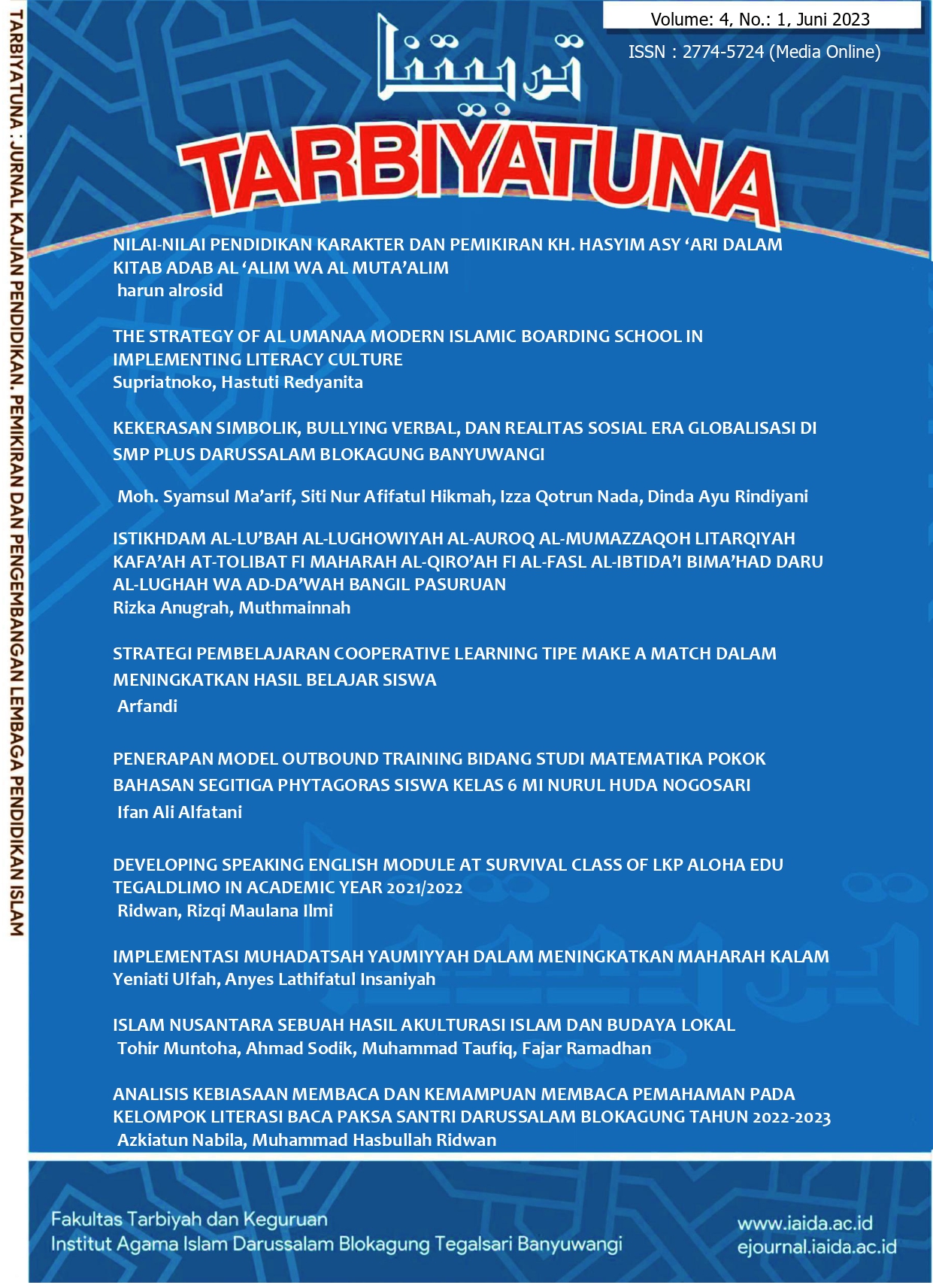
IMPLEMENTASI MUHADATSAH YAUMIYYAH DALAM MENINGKATKAN MAHARAH KALAM
DOI:
https://doi.org/10.30739/tarbiyatuna.v4i1.2448Keywords:
Implementasi, Muhadatsah Yaumiyyah, Maharah KalamAbstract
Maharah kalam is one of the language skills to be achieved in learning Arabic. This study aims to determine the implementation of muhadatsah yaumiyah in increasing maharah kalam at Madrasah Diniyah Al-Amiriyah Pondok Pesantren Darussalam Blokagung Banyuwangi. This research is a qualitative descriptive research with data collection techniques of observation, interviews, and documentation. The results of this study are first, that all students are accustomed to speaking Arabic when attending Arabic lessons at Madrasah Diniyah. Second, students become more confident when speaking Arabic without feeling embarrassed and afraid of being wrong. Third, students are increasingly diligent in memorizing mufradat every day. And fourth, students always practice muhadatsah so that they become more fluent and fluent when speaking, so that students are spontaneously able to communicate in Arabic anywhere and anytime.
Downloads
References
Anwar, Tayas Yusufdan Saiful 1995. Metodologi Pembelajaran dan Bahasa Arab. Jakarta: PT. Grafindo Persada.
Asnawi, Harun. 2021. Guru Pamong Bahasa Arab dan ketua yayasan durusul falah. Wawancara Ahli tanggal 05 mei 2021.
Charis, Abdullah. 2017. Cara Mudah Berbicara Bahasa Arab. Sidoarjo: Lisan Arabi
Effendy, Ahmad Fuad 2012. Metodologi Pengajaran Bahasa Arab. Malang. MISYKAT.
Effendy, Ahmad Fuad 2009. Metodologi Pengajaran Bahasa Arab. Malang. MISYKAT.
Hastang, Nur. 2017. Penerapan Metode Muhadatsah Dalam Meningkatkan Hasil Belajar Maharah Kalam. Lentera Pendidikan.
Hermawan. Acep 2018, Metodologi Pembelajaran Bahasa Arab, Bandung: PT REMAJA ROSDAKARYA.
Insaniyah, A. L., & Angraeni, R. (2022). Kesulitan Belajar Pasca Pendemi COVID-19 di MTs Al-Amiriyah Blokagung Banyuwangi. TADRIS AL-ARABIYAT: Jurnal Kajian Ilmu Pendidikan Bahasa Arab, 2(2), 218–232. https://doi.org/10.30739/arabiyat.v2i2.1627
Izzan, Ahmad, 2009. Metodologi Pembelajaran Bahasa Arab. Bandung: Humaniora.
Marhijanto, Bambang. 1993. Kamus Lengkap Bahasa Indonesia. Surabaya: TERBIT TERANG)
Munawwir, Ahmad Warson. 1984. Kamus al-Munawwir Arab-Indonesia Terlengkap. Surabaya: Pustaka Progresif.
Nadira, 2021. Siswa Kelas VII MTs BPD Debowae. Wawancara Tanggal 06 Mei 2021.
Wahyono, Endri. Kepala Sekolah MTs BPD Debowae. Wawancara tanggal 02 Mei 2021
Rohman, Fathur. 2015. Metodologi Pembelajaran Bahasa Arab. Malang: Madani Kelompok Intrans Publishing.
Setianingtiyas, Firdaus Dwi. 2018. Evektivitas Muhadatsah Yaumiyah Dalam meningkatkan Maharah Al-Kalam Bahasa Arab Di MA Darul Amanah Kendal. Lentera Pendidikan.
Sukmadinata, Nana Syaodih. 2020. Metode Penelitian Pendidikan. Bandung: PT Remaja Rosdakarya.
Sugiyono. 2015. Metode Penelitian Kuantitatif, kualitatif, dan R&D . Bandung: PT Alfabeta.
Syamsudin, Ahmad Soni, 2013. Penerapan Model Muhadatsah Yaumiyyah Untuk Meningkatkan Kemahiran Berbicara Bahasa Arab Siswa Kelas X.10 Man 01 Kota Magelang. Lentera Pendidikan.
Tarigan, Henry Guntur. 1990. Bahasa Sebagai Keterampilan Berbahasa. Bandung: Angkasa.
Downloads
Published
How to Cite
Issue
Section
Citation Check
License
Copyright (c) 2023 Yeniati Ulfah, Anyes Lathifatul Insaniyah

This work is licensed under a Creative Commons Attribution-ShareAlike 4.0 International License.
Authors who publish in Jurnal Tarbiyatuna: Jurnal Kajian Pendidikan, Pemikiran dan Pengembangan Pendidikan Islam agree to the following terms:
- Authors retain copyright and grant the journal right of first publication with the work simultaneously licensed under a Attribution-ShareAlike 4.0 International (CC BY-SA 4.0) Licensethat allows others to share the work with an acknowledgment of the work's authorship and initial publication in this journal.
- Authors are able to enter into separate, additional contractual arrangements for the non-exclusive distribution of the journal's published version of the work (e.g., post it to an institutional repository or publish it in a book), with an acknowledgment of its initial publication in this journal.
- Authors are permitted and encouraged to post their work online (e.g., in institutional repositories or on their website) prior to and during the submission process, as it can lead to productive exchanges, as well as earlier and greater citation of published work (See The Effect of Open Access).