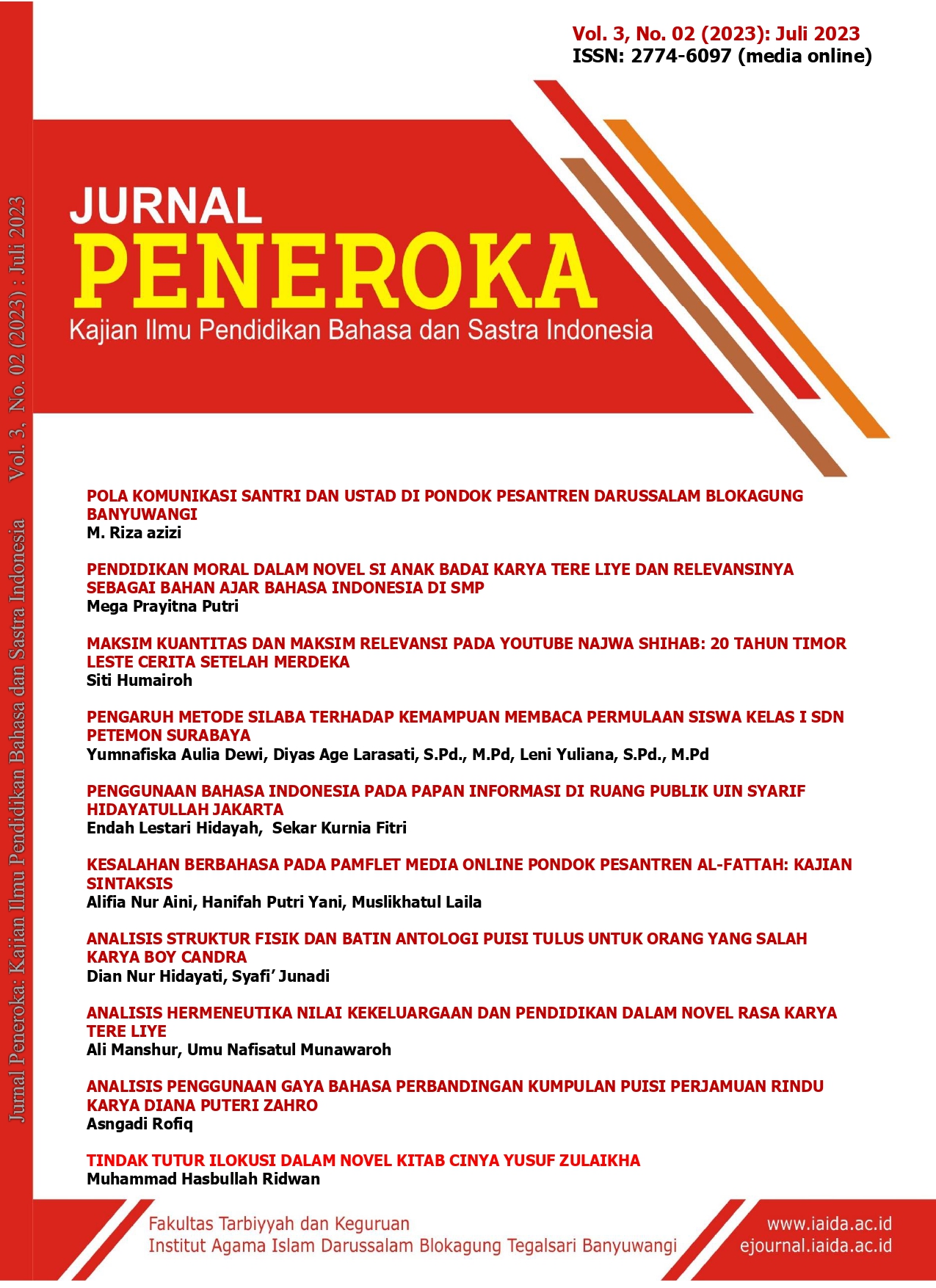
ANALISIS STRUKTUR FISIK DAN BATIN ANTOLOGI PUISI TULUS UNTUK ORANG YANG SALAH KARYA BOY CANDRA
DOI:
https://doi.org/10.30739/peneroka.v3i2.2405Abstrak
This study aims to describe: (1) the physical and mental structures in the anthology of poetry Sincere For The Wrong People by Boy Candra 2022; (2) the use of physical and mental structures in an anthology of poetry Sincere For The Wrong People by Boy Candra 2022. The researcher used a descriptive qualitative method with a structural approach. Data analysis techniques include data collection, data reduction, data presentation, and drawing conclusions. validity test is done by triangulation. As for the physical and mental structures in the poetry anthology Sincere For The Wrong People by Boy Candra 2022. a. Physical structure (1) Diction (37 words with connotative meaning), (2) Images (23 visual images, 2 auditory images, 9 tactile images, and 1 tasting images), (3) Concrete words (35 words), (4) Figurative language (4 metaphors, 12 personifications, 16 hyperboles), (5) Typography (2 stanzas 5 poems, three stanzas 5 poems). b. Inner structure (1) Theme (overall on the theme of romance), (2) Taste (found 9 kinds of feelings namely: sad, disappointed, disgusted, resigned, anxious, angry, hate, sad, and empty), (3) Tone and Atmosphere (the tone is sad, gloomy, disappointed, while the atmosphere is sad, suffering, sad, and anxious), (4) Mandate (the whole poem has a message with implied meaning).
Unduhan
Referensi
Ahyar, Juni. 2019. Apa Itu Sastra?. Sleman: DEEPUBLISH.
Bahtiar, Ahmad dkk. 2017. Kajian Puisi. Tangerang: PT Pustaka Mandiri.
Candra, Boy. 2022. Tulus Untuk Orang Yang Salah. Jakarta: Gramedia Widisarana Indonesia.
Fauziyah, Fika Z, Laela Sari N.H, Prasanti Dwigita A. 2022. Analisis Gaya Bahasa dan Makna Diksi Puisi ‘’SAJAK MALAM’’ Karya Heri Isnaini Dalam Montase Sepilihan Sajak, 1(1):76-85.
Gasong, Dina. 2022. Kajian Puisi. Yogyakarta: DEEPUBLISH.
Hamzah, Amir. 2020. Metode Penelitian Kualitatif. Malang: Literasi Nusantara.
Harun, Mohd. 2018. Pembelajaran Puisi Untuk Mahasiswa. Banda Aceh: Syiah Kuala University Press.
Junadi, Syafi’, Atina Khoirun Nisa. 2021. Analisis Idiomatik pada Novel Dua Barista Karya Najhaty Sharma. 1(2): 248-258.
Mahsun, M.S. 2017. Metode Penelitian Bahasa. Depok: Rajawali Pres
Moleong, Lexy J. 2021. Metodologi Penelitian Kualitatif. Bandung: PT Remaja Rosdakarya.
Nurgiantoro, Burhan. 2019 . Stilistika. Yogyakarta: Gadjah Mada University Press.
Sugiyono. 2022. Metode Penelitian Kualitatif. Bandung: CV Alfabeta.
Susana, Ramlah: 2020. Analisis Penggunaan Diksi dan Gaya Bahasa Dalam Buku The Miracle Of You (Ciptakan Keajaiban Dalam Diri Anda) Karya Sarwandi Eka Sarbini. Skripsi. Makasar: Jurusan Pendidikan Bahasa dan Sastra Indonesia Universitas Muhammadiyah Makasar.
Toyidin. 2022. Memahami Bunyi Puisi Teori dan Analisis. Yogyakarta: Textium.
Tuti, Neng Novianty. 2022. Kajian Struktural Pada Puisi ‘’KEKASIHKU’’ Karya Joko Pinurbo, 1(3): 22-23.
Unduhan
Diterbitkan
Cara Mengutip
Terbitan
Bagian
Citation Check
Lisensi
Hak Cipta (c) 2023 Dian Nur Hidayati, Syafi’ Junadi

Artikel ini berlisensiCreative Commons Attribution-ShareAlike 4.0 International License.
Authors who publish in Jurnal PENEROKA: Kajian Ilmu Pendidikan Bahasa dan Sastra Indonesia agree to the following terms:
- Authors retain copyright and grant the journal right of first publication with the work simultaneously licensed under a Attribution-ShareAlike 4.0 International (CC BY-SA 4.0) License that allows others to share the work with an acknowledgment of the work's authorship and initial publication in this journal.
- Authors are able to enter into separate, additional contractual arrangements for the non-exclusive distribution of the journal's published version of the work (e.g., post it to an institutional repository or publish it in a book), with an acknowledgment of its initial publication in this journal.
- Authors are permitted and encouraged to post their work online (e.g., in institutional repositories or on their website) prior to and during the submission process, as it can lead to productive exchanges, as well as earlier and greater citation of published work (See The Effect of Open Access).