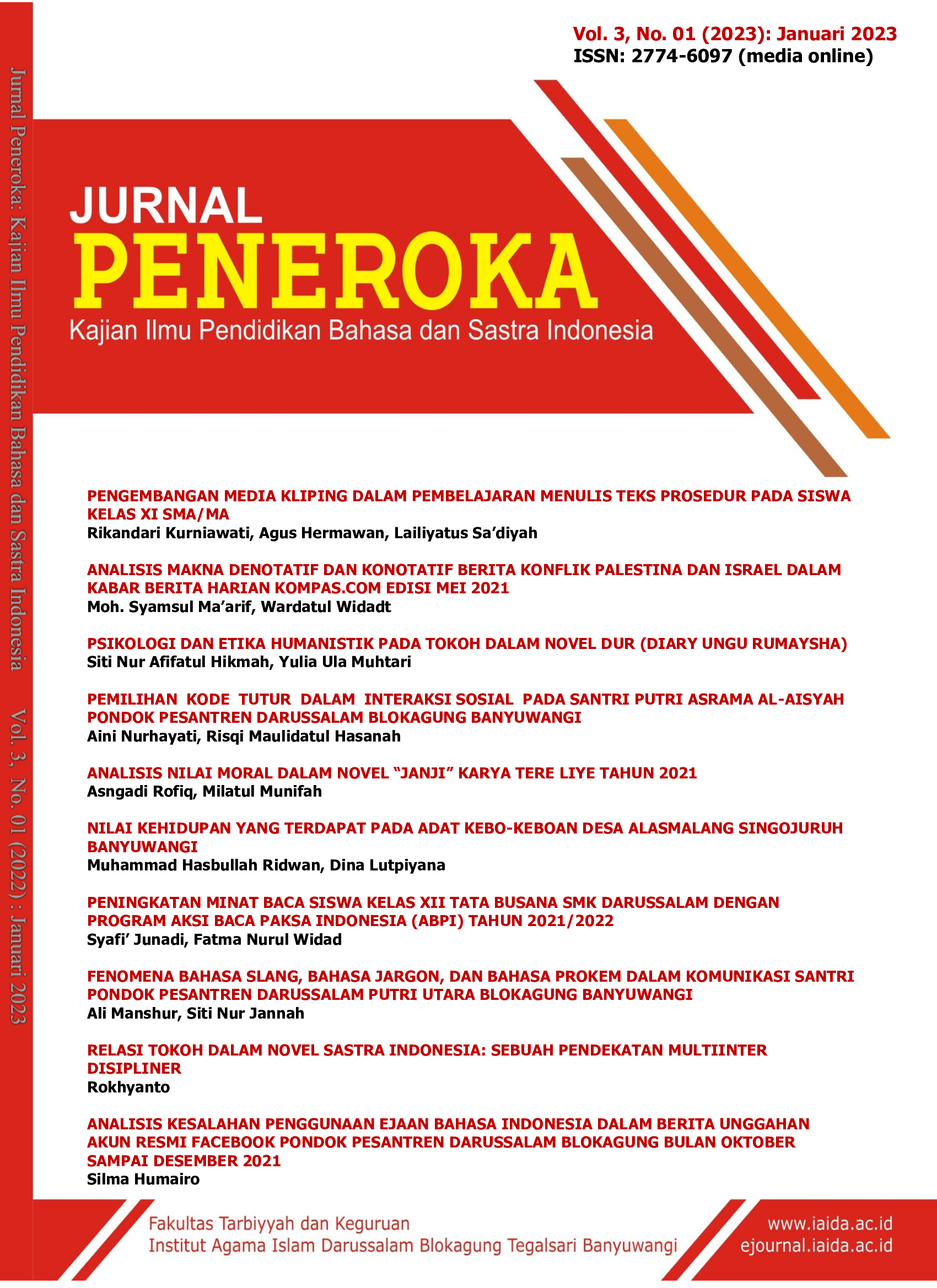
ANALISIS KESALAHAN PENGGUNAAN EJAAN BAHASA INDONESIA DALAM BERITA UNGGAHAN AKUN RESMI FACEBOOK PONDOK PESANTREN DARUSSALAM BLOKAGUNG BULAN OKTOBER SAMPAI DESEMBER 2021
DOI:
https://doi.org/10.30739/peneroka.v3i1.2027Keywords:
Spelling, News, and Facebook UploadAbstract
This research was conducted to describe the form of Indonesian spelling errors in the news uploaded to Pondok Pesantren Darussalam's facebook page and to find out the form of correcting Indonesian spelling errors in the news uploaded to Pondok Pesantren Darussalam's facebook page. The method used in this research is descriptive qualitative. The techniques used for research are tapping techniques, speaking techniques free of involvement, and note-taking techniques. Research that is included in this syntactic level, more specifically related to spelling errors, the researcher describes errors in the use of letters, punctuation errors, word writing errors, and absorption word writing errors found in news uploaded to Pondok Pesanren Darussalam Blokagung's Facebook Facebook. The results and conclusions of this study are that there are 297 forms of errors consisting of (a) 184 errors in the use of letters, (b) 81 errors in writing words, (c) 13 errors in the use of punctuation marks, (d) writing errors absorption words as many as 19 errors. Therefore, the highest number of errors occurs in the use of letters.
Downloads
References
Alwi, Hasan, Dkk. 2010. Tata Bahasa Baku Bahasa Indonesia. Balai Pustaka. Jakarta.
Aji, Endro. 2017. Beberapa Kesalahan Ejaan Dalam Jurnal Ilmiah Kesehatan Olahraga Medikora. Jawa Tengah: Balai Bahasa.
Badudu, J. S. 1986. Inilah Bahasa Indonesia yang benar. PT Gramedia. Jakarta
Dardjowidjojo, Soenjono. 2014. Psikolinguistik Pengantar Pemahaman Bahasa Manusia. Yayasan Pustaka Obor. Jakarta.
Djuraid, Husnun. 2013. Panduan Menulis Berita. 2012. UMM Pres. Malang
Hani’ah, Munnal. 2018. Panduan Terlengkap PUEBI. Laksana. Yogyakarta.
Moleong, Lexy J. 2016. Metode Penelitian Kualitatif. Bandung: PT. Remaja Rosdakarya.
Muhammad. 2016. Metode Penelitian Bahasa. Yogyakarta: Ar-Ruzz Media.
Pratikasari, Risang. Khairani, Nazlah. Digananda, Syarafina. Ulya, Chafit. 2020. Analisis Kesalahan Ejaan Pada Jurnal Imajeri Pendidikan Bahasa Dan Sastra Indonesia Universitas Muhammadiyah Prof. Dr. Hamka. Universitas Sebelas Maret Surakarta.
Setyawati, Nanik. 2013. Analisis Kesalahan Berbahasa. Yuma Pustaka. Surakarta
Sugiyono. 2016. Metode Penelitian Kuantitatif, kualitatif dan R&D. Bandung: Alfabeta Bandung.
Sudaryanto. 2015. Metode Dan Aneka Teknik Analisis Bahasa. Malang: Setara Pres
Tarigan, Guntur. 2013. Menulis Sebagai Keterampilan Berbahasa. Angkasa Bandung. Bandung
Wijayanti, Atrianing. 2016. Analisis Kesalahan Penggunaan Ejaan Pada Skripsi Mahasiswa Program Studi Di Pendidikan Guru Sekolah Dasarfakultas Keguruan Dan Ilmu Pendidikan Universitas Darul Ulum Islamic Centre Sudirman Guppi Undaris. PGSD Undaris.
Yanti, Asma. Rafidhah Hanum. Silvia Sandi Wisuda Lubis. 2015. Analisis Penggunaan Ejaan Yang Disempurnakan (Eyd) Dalam Tulisan Artikel Di Media Sosial. Pgmi-Ftk Uin Ar-Raniry Banda Aceh
http. Facebook Pondok Pesantren Darussalam. Diakses 2 Januari 2022.
Downloads
Published
How to Cite
Issue
Section
Citation Check
License
Copyright (c) 2023 Silma Humairo

This work is licensed under a Creative Commons Attribution-ShareAlike 4.0 International License.
Authors who publish in Jurnal PENEROKA: Kajian Ilmu Pendidikan Bahasa dan Sastra Indonesia agree to the following terms:
- Authors retain copyright and grant the journal right of first publication with the work simultaneously licensed under a Attribution-ShareAlike 4.0 International (CC BY-SA 4.0) License that allows others to share the work with an acknowledgment of the work's authorship and initial publication in this journal.
- Authors are able to enter into separate, additional contractual arrangements for the non-exclusive distribution of the journal's published version of the work (e.g., post it to an institutional repository or publish it in a book), with an acknowledgment of its initial publication in this journal.
- Authors are permitted and encouraged to post their work online (e.g., in institutional repositories or on their website) prior to and during the submission process, as it can lead to productive exchanges, as well as earlier and greater citation of published work (See The Effect of Open Access).