PENGARUH METODE SILABA TERHADAP KEMAMPUAN MEMBACA PERMULAAN SISWA KELAS I SDN PETEMON SURABAYA
DOI:
https://doi.org/10.30739/peneroka.v3i2.2372Keywords:
Metode Silaba, Kemampuan Membaca PermulaanAbstract
This research is motivated by the low score achieved by students in the beginning reading ability in the Indonesian language subject. One way that can be used to overcome this problem is to apply the syllabus method. The purpose of this study was to describe the effect of the silaba method on the reading ability of first grade students at SDN Petemon Surabaya. The type of research used in this research is quantitative research using experimental methods, with the type of Pretest-Posttest Control Group Design. This study used the firstclass population at SDN Petemon Surabaya. Two classes were selected using a random sampling technique by lottery as the research sample. Class I-C consists of 25 students as an experimental class. Class I-A consists of 25 students as the control class. The instrument of this study used observation sheets and questions (pretest and posttest) in the form of literacy, totaling 5 questions. The data collection technique uses scoring on the results of observations and pretest and posttest assessment standards. The tests used were the normality test, homogeneity test and the T test were used to test the results of the research data. The results of the research data showed that the posttest average of the experimental class was , which was higher than the control class, which was . The results of the data using the t-test. The results of calculating t Count obtained a value of followed by looking for a t table based on the df value of 48 with a level value of showing a result of . This proves that there is an influence of the silaba method on the beginning reading ability of first grade students at SDN Petemon Surabaya.
Downloads
References
Alsalimatus Sa’diyah, N. K. U. (2022). Pengaruh Metode Silaba terhadap Keterampilan Menulis Huruf Tegak Bersambung Di Kelas I Sekolah Dasar. Jurnal Literasi Pendidikan Dasar, 3(2), 12–22.
Anif Isnatunnikmah. (2016). Metode Silaba Terhadap Kemampuan Membaca Permulaan Anak Disleksia Kelas 3 Di Sd. Jurnal Pendidikan Khusus, 1–10.
Azizi, M. R. (2023). Pola Komunikasi Santri dan Ustad di Pondok Pesantren Darussalam Blokagung Banyuwangi. Jurnal Kajian Ilmu Pendidikan Bahasa Dan Sastra Indonesia, 3(2), 172–183.
Fitri, T. C. (2022). Penerapan Metode Silaba Berbantu Media Kartu Suka (Suku Kata) dalam Meningkatkan Kemampuan Membaca Permulaan Siswa Kelas I di SDN Kurungan Nyawa Oku Timur.
Khotimah, S. K. (2018). Pengaruh Metode Silaba Terhadap Kemampuan Membaca Permulaan Siswa Kelas 1 MI Salafiyah Kota Cirebon. 1(1).
Larasati, D. A. (2020). Pengaruh Model Discovery Learning Berbasis Higher Order Thinking Skill Terhadap Kemampuan Berpikir Kritis. VOX EDUKASI: Jurnal Ilmiah Ilmu Pendidikan, 11(1), 39–47. https://doi.org/10.31932/ve.v11i1.684
Meilina Fiani, I. (2022). Efektivitas Metode Silaba dalam Meningkatkan Kemampuan Membaca Permulaan bagi Siswa Disleksia di SDN 17 Jawa Gadut. Jurnal Pendidikan Dan Konseling, 4, 2556–2560.
Ulfa, M. (2018). Terampil Memilih dan Menggunakan Metode Pembelajaran. Terampil Memilih Dan Menggunakan Metode Pembelajaran, 30, 35–56.
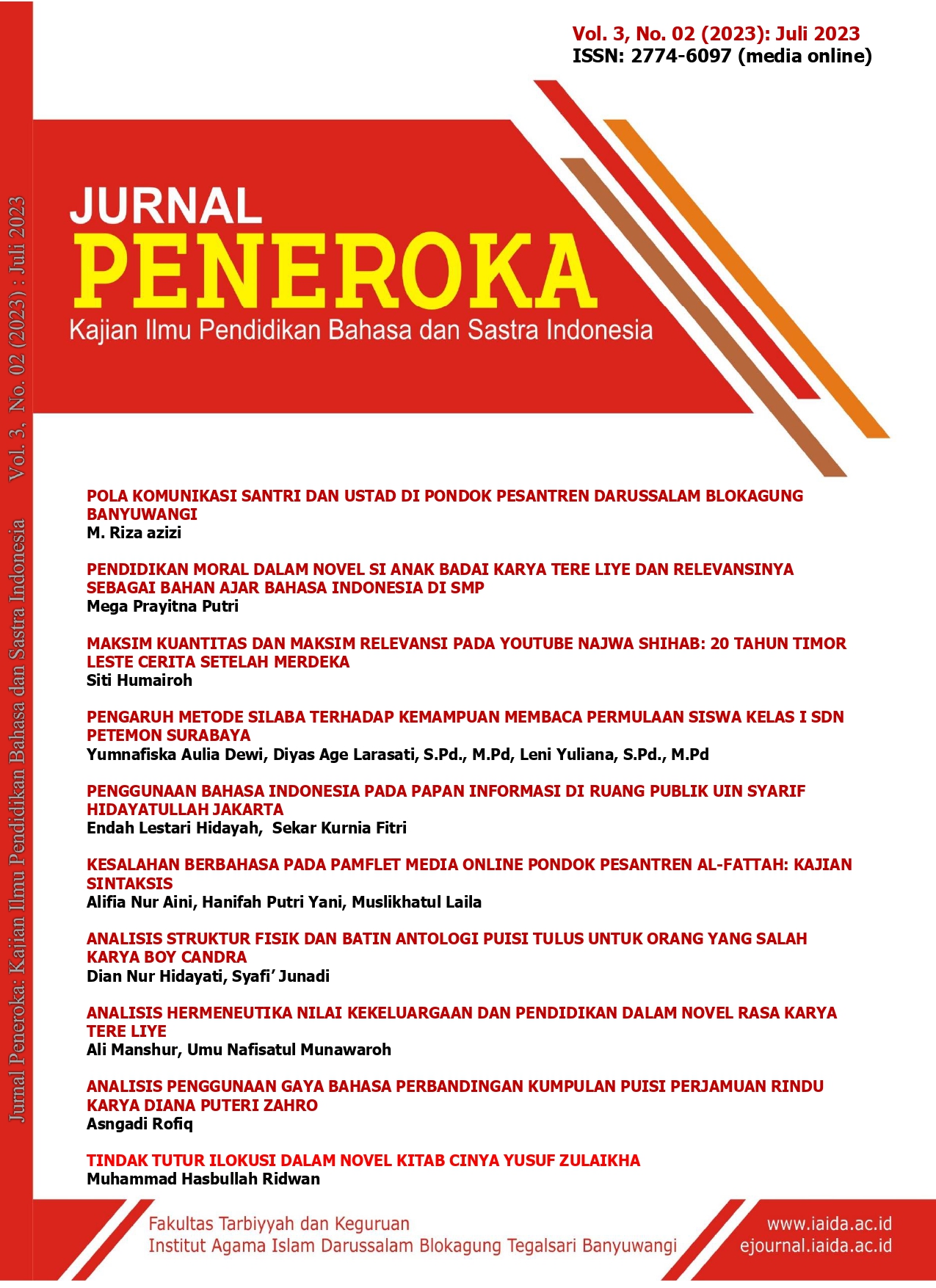
Downloads
Published
How to Cite
Issue
Section
Citation Check
License
Copyright (c) 2023 Yumnafiska Aulia Dewi, Diyas Age Larasati, Leni Yuliana Yuliana

This work is licensed under a Creative Commons Attribution-ShareAlike 4.0 International License.
Authors who publish in Jurnal PENEROKA: Kajian Ilmu Pendidikan Bahasa dan Sastra Indonesia agree to the following terms:
- Authors retain copyright and grant the journal right of first publication with the work simultaneously licensed under a Attribution-ShareAlike 4.0 International (CC BY-SA 4.0) License that allows others to share the work with an acknowledgment of the work's authorship and initial publication in this journal.
- Authors are able to enter into separate, additional contractual arrangements for the non-exclusive distribution of the journal's published version of the work (e.g., post it to an institutional repository or publish it in a book), with an acknowledgment of its initial publication in this journal.
- Authors are permitted and encouraged to post their work online (e.g., in institutional repositories or on their website) prior to and during the submission process, as it can lead to productive exchanges, as well as earlier and greater citation of published work (See The Effect of Open Access).