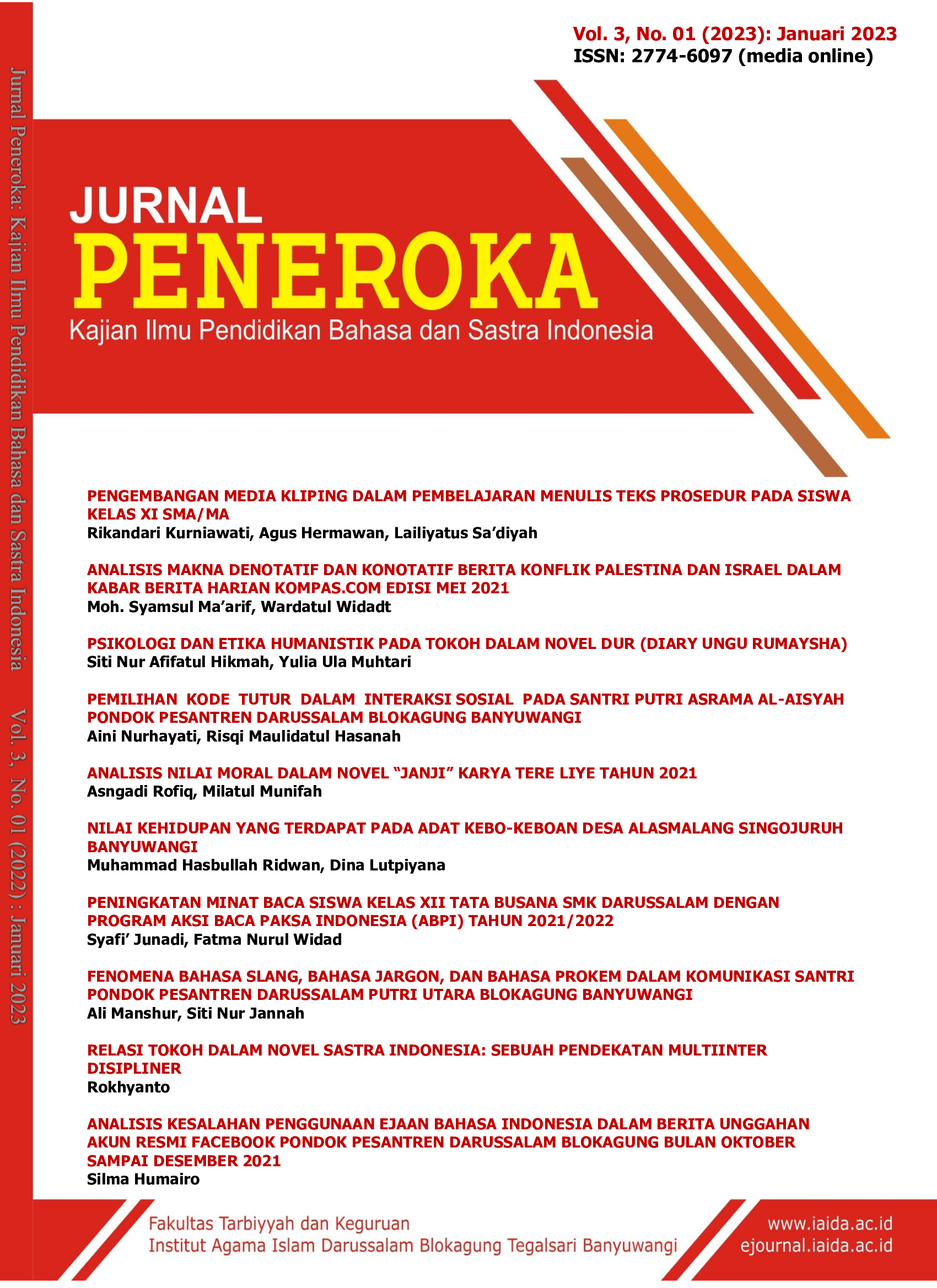
FENOMENA BAHASA SLANG, BAHASA JARGON, DAN BAHASA PROKEM DALAM KOMUNIKASI SANTRI PONDOK PESANTREN DARUSSALAM PUTRI UTARA BLOKAGUNG BANYUWANGI
DOI:
https://doi.org/10.30739/peneroka.v3i1.1950Keywords:
Variety of Languages, Forms, and MeaningsAbstract
The phenomenon of the emergence of various languages ??used by groups which makes language users more creative and innovative. Especially students who have different cultural backgrounds. Often students communicate by changing the language that the students can understand only. The languages ??used are called slang, prokem, and pesantren jargon. The aims of this study were to: 1) describe the various forms of slang, jargon, and prokem in the communication of the students of the Darusaalm Putri Utara Islamic Boarding School. 2) Describe the meaning in the use of various pesantren languages ??in the communication of the students of the Darussalam Putri Utara Islamic Boarding School, Blokagung Banyuwangi. This study uses a qualitative descriptive method that can help identify various factors and information in the Darussalam Putri Utara Islamic Boarding School. The conclusions of this study: 1) Variety of langue; a) Islamic boarding school slang is a variety of languages ??that are special and secret, meaning that the language is only used in Islamic Boarding Schools with a total of 28 words. 2b) Pesantren jargon language is a variety of languages ??used in Islamic boarding schools, but they are not secret, totaling 27 words. c) Prokem language is a variety of slang used in daily communication to increase the intimacy between students, totaling 44 words. 2) The meaning of the variety of languages ??contained in each word of slang, jargon, and program boarding schools is the meaning given by the user as another form of the meaning of the basic word of the language variety.
Downloads
References
Aslinda dan Leni Syafyahya. 2014. Pengantar Sosiolinguistik. 2014. Bandung: PT Refika Aditama.
Chaer, Abdul dan Agustina. 2014. Sosiolinguistik Perkenalan Awal. Jakarta: PT Rineka Cipta.
Chaer, Abdul. 2014. Linguistik Umum. Jakarta: PT Rineka Cipta.
Manshur, Ali. 2021. Pemerolehan Bahasa Anak Usia 3-4 Tahun Di Desa Tegalrejo Banyuwangi Dalam Kajian Psikolinguistik. Jurnal PENEROKA Vol. 1, No. 02. Prodi Tadris Bahasa Indonesia IAI Darussalam Blokagung Banyuwangi.
Millah, Izzatul. Skripsi. 2020. Ragam Bahasa Slang Dalam Komunikasi Santri Di Pondok Pesantren Annuqoyyah Latte II. Skripsi Diterbitkan. Sumenep. Program S1 STKIP PGRI. (Diakses 28.11.2021: 23.31).
Oktaviani, Femi. 2014. Hubungan Antara Penggunaan Bahasa Gaul Dengan Keterbukaan Komunikasi Di Kalangan Siswa. Jurnal Komunikasi. Vol.1. No. Universitas BSI. Bandung.
Rahmah Annisa. 2018. Analisis Ragam Bahasa Wanita Malam Di Kawasan Simpang Pemda. Skripsi Diterbitkan. Medan. Fakultas Keguruan Dan Ilmu Pendidikan Universitas Muhammadiyah Sumatera Utara. (Diakses 05.12.2021: 08.58).
Sugiyono. 2018. Metode Penelitian Kualitatif. Bandung. ALFABETA.
Wijana, I Dewa Putu & Muhammad Rohmadi. 2013. Sosiolinguistik: Kajian
Teori dan Analisis. Yogyakarta: Pustaka Belajar.
Downloads
Published
How to Cite
Issue
Section
Citation Check
License
Copyright (c) 2023 Ali Manshur, Siti Nur jannah

This work is licensed under a Creative Commons Attribution-ShareAlike 4.0 International License.
Authors who publish in Jurnal PENEROKA: Kajian Ilmu Pendidikan Bahasa dan Sastra Indonesia agree to the following terms:
- Authors retain copyright and grant the journal right of first publication with the work simultaneously licensed under a Attribution-ShareAlike 4.0 International (CC BY-SA 4.0) License that allows others to share the work with an acknowledgment of the work's authorship and initial publication in this journal.
- Authors are able to enter into separate, additional contractual arrangements for the non-exclusive distribution of the journal's published version of the work (e.g., post it to an institutional repository or publish it in a book), with an acknowledgment of its initial publication in this journal.
- Authors are permitted and encouraged to post their work online (e.g., in institutional repositories or on their website) prior to and during the submission process, as it can lead to productive exchanges, as well as earlier and greater citation of published work (See The Effect of Open Access).